Showing posts with label Misc. Show all posts

Tuesday, September 17, 2013

BLOG 54. One Shoe Fits all in the BWCA


BLOG 54. ONE SHOE FITS ALL IN THE BOUNDARY WATERS!
by Cliff Jacobson

 
Cliff: solo/BWCA
I recently returned from my annual fall solo canoe trip into the Boundary Waters.  My experience began at the Tofte ranger station* where for the nth time, I was asked to watch the seven minute ethics video that is required of all visitors.  I politely told the ranger that I had seen the video at least 100 times, and when I taught school, I owned a copy and showed it to all my classes when I taught the unit on wilderness ethics. No matter; I’d have to watch it again.  Besides, said the clerk, “It will take me seven minutes to process your permit.”  Really?

On a positive note, I see the feds have abandoned the dangerous advice to  “throw rocks at a bear that comes into your camp—and try to hit it!”  We did that once on a canoe trip in northern Saskatchewan and the bear nearly had us for lunch!  I would throw rocks only as a last resort, when human life is in danger!

More goofy things: Firewood should be thumb-thick sticks, breakable by hand, not sawn and split logs. Really? I’ve never seen anyone rely solely on twig fires in the BWCA. Indeed, there’s plenty of good sized, dead, down wood (well away from campsites). The major cause of  wildfires in the Boundary Waters is that decomposition can’t keep pace with annual litter fall, so dead wood builds over time and creates a fire hazard. A big roaring fire in every campsite every night would not measurably reduce the amount of dead, downed wood in the forest, so why this silly rule? Because the government wants one shoe to fit all—what applies to Zion national park must apply to the Boundary Waters, deserts, mountains and swamps—no matter that there ARE important ecological differences.  I once paddled by a campsite occupied by Forest Service workers.  They had a BIG roaring fire going—there wasn’t a twig in sight!
 
Yes, the Littlbug (www.littlbug.com) stove is legal in the BWCA.  You must place it next to the fire grate. The split wood here will burn for many hours
Surprisingly, safety on the water is not discussed. There is no stern warning to “wear your life jacket while canoeing”!  Less than half the paddlers I saw on my trip wore life jackets, this despite the fact that almost every year someone drowns in the Boundary Waters.  Shouldn’t the film address this concern?  Capsize in running waves and the wind may quickly blow your canoe out of reach (more so with today’s ultralight Kevlar boats), leaving you with a long swim to shore.  I saw an example of this on my trip. Three people in a Kevlar canoe were paddling directly across Ham Lake. The waves were about 18 inches high and running strong. No one wore life jackets.  The paddlers didn’t have a clue that a capsize could be serious. Why? Because if you’ve never tipped over in waves while wearing field clothes and boots, you can’t appreciate the danger. The saying: “Canoeists always wear their life vests; ‘canoers’ never wear them! Tells all.

Instead of life-saving or practical advice, visitors are told to filter their dish water through a mesh towel. Really? This makes sense for eco-delicate alpine areas but it’s over-kill for the northern coniferous forest where decomposition occurs more rapidly.  Really now, does anyone really strain their dish water in the BW?

You are also told to “carry out your trash—all of it”.  This is idealistically correct.  However, plastic food bags and aluminum foil comprise most trash, and food wastes that cling to the bags WILL attract animals—mice, squirrels and yes, bears!  Best to burn the trash in a good hot fire THEN carry out what didn’t burn.

Wouldn’t our beloved Boundary Waters be better served with common sense regulations and a view towards reality?

*All permit information is now on line so you no longer need to specify where to pick up your permit.  Any ranger station can access the information.

Cliff Jacobson
www.cliff-jacobson.com

Wednesday, September 4, 2013

BLOG 53. You Saved Us!


BLOG 53. You Saved Us

This is from Caitlin Looney, a wilderness therapist in Colorado. Caitlin was guiding a group of teenagers and turned a “lost experience” into a confidence-building, inspirational event.  Caitlin did everything exactly right. Follow along on the map as you read her story. Note that her choices reflect an in-depth understanding of backcountry navigation.
Cliff
------------------------------------------------------
Hello Cliff:

I am a wilderness therapist in the Rockies of Colorado. The majority of my work happens front country with kayaking, challenge courses, hiking, and fishing as my modalities. However, once a year I co-lead a trip with 10 eighteen year olds into the backcountry of the Rocky Mountain National Park. The majority of the trip is on trail with the exception of one day when we complete a peak ascent. This year was my fifth year leading this trip and peak ascent (Mt. Orton) in the same region. I always give the students a short orienteering lesson along with maps and compasses before we head up. On the way back down from the peak, I offer them the opportunity to lead for a while (after all, they just have to go downhill, right?!).


Well, this year things didn't quite go as planned! One of the students in the back was having a hard time, so my co-leader and I focused our attention on him. I was subtly aware that we had cleared a ridge and the downhill had begun to take us south when we should have been traveling east, but I wasn't too worried because we had some room for error since our campsite was next to a fairly large lake, Sandbeach Lake. By the time I decided to take back the reins, so to speak, three of the students had picked up their pace to a steady trot and split off in two directions. I matched their pace and got the whole crew back together, all the while becoming aware that in my hustle, I had lost my bearings. But, I saw an opening through the trees that looked like a lake, so we headed for that... Well, it was a lake. But it wasn't OUR lake!

I had never been lost before, let alone while in charge of ten other people! Honestly, what I did next was very stupid. I panicked and focused on hiding our "lost" status from the students. I didn't want to worry them... So instead of opening the whole topo map, I glanced at an area on the folded up map where a nearby lake was and rapidly pointed northeast and began walking. I came to my senses about a quarter mile later and stopped to open the map and discuss with my co leader. Near the "unknown lake" we had found, we had also crossed a southernly flowing stream. There was a north-south river on the map, but I wasn't certain that it was the stream we had crossed. The stream we had crossed was small and the river on the 1:40,000 map appeared to be quite a bit bigger. So now I was in the terrifying position of not knowing if we were southwest or southeast of our campsite. In that moment I experienced fear like I had never known. My mouth went totally dry and I could barely speak to the students. However, I did manage a smile and some reassuring words. It had begun raining and we had two hours of daylight left. My co leader and I began to take inventory of our emergency supplies (we only had daypacks) and make plans for creating a temporary shelter and camping in the forest for the night. Then it hit me! I had read your book, "The Basic Essentials of Map & Compass" (1988), the previous summer. I was on a bus tour vacation and thought it was a good time to learn more than how to read contour lines. I had attempted reading other orienteering books in the past, but they were always too abstract, and honestly a bit arrogant, for me. But your book was so clear, concise, and humble in the way you wrote it. You really normalized the experience of getting disoriented in the wilderness. The line drawings and map examples were so applicable to my experience that I decided to read it twice!

So, I halted our emergency plans and went back to the map. The forest was so thick around us that we couldn't  see anything to triangulate our position. My co leader and I scrambled up to a rock outcropping, but all we could see were ponderosa pines in every direction and a silhouette of the continental divide in the west. So, I knew what Cliff would tell me to do! The only thing I was certain of was north. I looked far north on the map. If we were on the east side of the lake and walked directly north, we would have to pass the lake, but would hit an east-west trail that led into our campsite. If we were on the west side of the lake and used a north bearing, we would bypass the lake by a bit of a distance, but hit a SE flowing river that would also lead us to the same trail. This meant a lot of extra walking for a group of cranky teenagers, but it also meant getting found before dark! So north we went and about an hour later walked directly into an east-west trail. I almost cried! But I didn't because I was still attempting to look competent and certain. I just nodded in a knowing way and turned left onto the trail. After heading west for 20 minutes, we walked right into camp as if it had been there waiting for us all along!

I know you probably get long-winded stories like this all of the time, but I really needed you to hear our tale. Mostly, I wanted to tell you that you saved us because you wrote a humble and accessible book about map and compass. Thank you, Cliff. I will never forget the lessons that you and the Wild Basin taught me that day.

Be well,
Caitlin Looney

Posted by Cliff Jacobson
www.cliff-jacobson.com


Wednesday, June 26, 2013

BLOG 48. Gray Beards


BLOG 48. GRAY BEARDS
by
Cliff Jacobson

A few years ago, I presented a program for the Minnesota Canoe Association. About 150 people attended.  With the exception of six teenage girls—who were there to show slides of their trip in the Boundary Waters—everyone (including me) had gray hair.  Murmurs of “look at all the gray beards” bounced around the room.

Gray is now largely the hair color of those who enjoy the Boundary Waters Canoe Area each summer. When, in 1968, at the age of 28, I made my first trip into this region, most of the paddlers were not much older than me.  Now, the average age is close to fifty. Where have all the young people gone?
 
Where have all the young people gone?  Cr. Mike Rapatz
To technology, mostly. Today’s kids would rather play on their computer than go outside. Few have ever gone canoeing, fewer still have camped out-of-sight of an RV. They have no use for wilderness. Richard Louve, addresses this concern in his book, Last Child in the Woods: Saving Our Children from Nature Deficit Disorder. Louv makes the case that kids are so consumed by TV and video games that they have lost their connection to the natural world—they see no value in wild places and therefore, no reason to preserve them. I taught eighth grade environmental science for 30 years and I can say he is right on target.
 
Cr. Mike Rapatz
What isn’t, is society’s view that kids must be flooded with (mostly useless) information and tested frequently to ascertain their knowledge of it. The result is that teachers have no time for social or environmental concerns. They must teach to tests that are designed by those who don’t hike, camp or canoe or give a wit about wilderness. Teachers who do take their students outdoors without meeting the “approved government objective”, are asking for trouble. If it’s not in the state-approved curriculum—or more accurately, “not on the test”—it’s not acceptable. Even nature centers are not immune from regulation. Where once, they could present a variety of interesting topics, they, like teachers, must now key into the “approved curriculum”.
 
Cr. Zoe Kesselring
Field trips?  What are they?  Or rather, what were they? Schools no longer have money for away-from-school activities. Field trips now are largely self-funded, meaning the kids—not the school--pays for the bus ride. Admittedly, a few (very few) teachers defy the odds and meticulously collect bus fare—usually two to five dollars per head.  Some kids pay, some don’t.  Caring administrators often look the other way. Ultimately, teachers tire of the extra work and the field trips just go away.

Then, there's the matter of party size in the BWCA. In the 1970's, when I began to take kids "up north", the party size was 10 and there was no limit on the number of canoes in the group. Our groups were all co-ed, nine kids and one teacher.  Now, two adult leaders are required for every teen group, and the maximum party size is nine.  This translates into seven paying teens, not nine as in the past. And with two leaders, expenses double.  No wonder school groups are largely a thing of the past.  Nine people and four canoes are the rule in the Boundary Waters, which means someone has to ride "dead weight"--hardly a good time for a teenager who wants to paddle. Frankly, I think that this rule should be re-visited. 

There's also the matter of "fun", or possibly the lack of it.  Get a group of kids together and they'll naturally make noise--singing, dancing on logs and yelling at their friends are part of the growing up game. And so is congregating with their friends. Yes, kids must learn to respect the quiet and sanctity of the wilderness, and it's our job to teach them.  Still, when they do forget the rules, we--and those around them--need to be compassionate.    

When I taught environmental science at Hastings Middle School (I retired in 2001), I offered free after school canoe trips on the nearby Mississippi River. We went twice a week when the weather was good, and always had a full house.  But now, with today’s ludicrous demands on teachers, I’d have no time for it.
 
Cr. Robyn Keyport
When snow covered the ground I took each of my classes on a half-day snowshoe hike.  The kids would ask: “Mr. J, what do we have to write down?”

            “Nothing!”.
            “But what do we have to know for the test?”
            “Won’t be on a test!”
            “Yeah, great, but then, why we goin’?”
            “Just for fun and to learn to love wild places.  Is that okay?”
            “Yeah, man, way cool!”

Get the point?  Too bad our politicians don’t. 

The result is that we’re raising a generation of youngsters who love malls more than trees.  And unless we change our educational expectations, and quickly, I fear that we will continue to lose more wilderness and more of our sanity.

www.cliff-jacobson.com

XXX

Wednesday, May 15, 2013

Ice on Burntside Lake Wednesday Morning, May 15, 2013 by Steve Piragis

Ice is hanging in on bigger lakes around the Boundary Waters.  Here are a couple images from this morning, Wednesday, at the landing on Van Vac Rd on Burntside Lake.  This is a deep lake and this is the widest part.  Bays are open and narrows but the big lakes indicated here are still covered with black ice.  The forecast calls for strong nw winds today after an unusually warm day with sw winds yesterday.  If you are planning a canoe trip for this week check in with us on your route for advise.  I'd expect ice out on all lakes by the weekend but this year's ice seems pretty tenacious.

Steve Piragis


Monday, May 13, 2013

Blog for American Rivers by Steve Piragis


Somehow rivers speak to us don't they?  More than placid lakes that lie still and demur asking only to be respected, rivers demand your attention.  Spring whirlpools turn to summer's lazy meanders and the surface for transporting leaf boats to the sea in fall.  Lakes seem safe in winter for us to ski or fish or camp but rivers have the unpredictable personality that tempts us to take a chance.  It's the the headwaters of big rivers that I love the most.  Small streams merge into medium streams.  Rocks, not mud dominates the benthos.  Hatches of midges and stoneflies emerge from cold waters then the best of all, the dragonflies of June walk out on a rock and unzip themselves down the back, unfurl their wings and set sail in the fragrant air of a blooming June day.  Such is the mood and the temperament of the Kawishiwi River winding its way thru the heart of America's canoe wilderness, the Boundary Waters of Minnesota. 

How could a wilderness river so pure for twelve thousand years since it's birth under glacial ice be threatened?  This gem, flowing tea amber from bogs and lakes that lie within the Precambrian bedrock, has a small problem.  A billion plus years before that last glacier melted during a time of crustal uproar these Algoman highlands were being injected from the mantle of the earth with a magma rich in metal ions hot to mate with the sulfur atoms in the country rock that this magma was invading.  The marriage made in hell lay dormant through a quarter of the earth's life until now.  Now the metals bound to their mate sulfur are immensely valuable to the planet's masters.  We, the members of the technology culture, have in insatiable and gluttonous appetite for metal.  The problem the Kawishiwi has is that these metals are sleeping in the crust just below the river and are being awakened by the core drillers taking biopsies to assess their riches.  Metals tied to sulphur in a sulfide marriage brought up to the light of day and the exposed to the rains and winds get divorced quickly and remarried hot to travel on the river as sulphuric acid and loose metal ions.  The river suffers when plants and frogs and fish burn out on the acid or suck up the metals to become toxic to the trophic layer above them.  

It's rather simple isn't it? Don't risk the life of one of the world's most pure rivers flowing through the heart of the most loved wilderness to feed the insatiable  appetite of this culture.  The river deserves our love and our willingness to fight for it;  even to commit to use less metals ourselves and enjoy our brief lives on this enduring planet more in the company of a river with personality, a river with life and liberty and purity, a river like the Kawishiwi.  


Steve Piragis

Tuesday, May 7, 2013

Boundary Waters Ice Out Update -- Not Yet

ICE OUT UPDATE:  Currently although we have a favorably warm forecast for the rest of the week with possible thundershowers tomorrow there is still 20" to 24" of ice on most of the lakes of any size.  Portages in the woods have a foot of snow on many that have tree cover.  Ice is beginning to pull away from the edges of the lakes.  As the week goes on we will keep you updated.  AS OF TUESDAY MORNING, THE FOREST SERVICE HASN'T DONE ANY FLY OVERS TO CHECK OUT THE ICE BUT THEY ARE LIKELY TO IN THE NEXT FEW DAYS.   If we get any first hand knowledge of openings, rivers, etc. WE WILL POST AS SOON AS WE KNOW ANYTHING.

Tuesday, April 23, 2013

How Important is the Boundary Waters to You?

Is the Boundary Waters important to you? Tell us how much in your own words by commenting below! Tell your friends about this wonderful place so that we can increase awareness for preserving this beautiful wilderness area! 


Tuesday, January 22, 2013

BLOG 36. Bobby


BLOG 36: Bobby
by
Cliff Jacobson

I first heard about Bobby in 1983, while canoeing the Hood River in the (then) Northwest Territories of Canada. In those days, there was a lot of exploratory mining north of 60 (the sixtieth parallel).  Bush camps and drill rigs sprung up in every suspecting spot and there was a constant drone of float planes to service them. For years following the mining rush, there were jobs galore for anyone who could tolerate uncivilized living.
Headwaters of the Hood River.  Start of our trip
Just prior to boarding our Twin Otter for the flight to Point Lake and the start of our Hood River canoe trip, Yellowknife Base manager Bill Gawletz pointed out a small knoll on our map, just east of Takijaq Lake, which was along our route.

            "This here's "Kid Creek" Camp," he said.  "We fly in there twice a month. They've got a radio and a chopper and can get you out if you have trouble.  The guys have been holed up there for two months now, so they're probably pretty bushed. Tell 'em I said they should feed you good."

Two weeks of strenuous travel brought us to Kid Creek Camp.  Located on a high hill, the stark white canvas tents were visible two miles away. Four men waited patiently on shore, eager for the diversion of new conversation.  A  mining engineer in his fifties appeared to be in command.  Nearby, was a muscular college kid from Saskatchewan who did the heavy work, a clean-shaven helicopter pilot named Brian, and a bushy, white-haired cook.  They said that Bobby, their young Inuit maintenance man and jack-of-all-trades, was gone for the day.
Hood River. Cliff Jacobson, Sue Harings and muskox

We meandered up to the cook tent where we were treated to blueberry and pumpkin pies, fresh-baked biscuits with jam and honey, coffee, tea, hot chocolate and candy bars galore. We offered to pay but they wouldn't hear of it. What they wanted was news from the south, and for the next two hours we deluged them with it.

Ultimately, the conversation got around to Bobby who was off in the bush fixing a drill rig.  They said he was  the best mechanic in the Territories--a quiet, likeable kid who could fix anything.  "We have a lot of fun with Bobby," chimed one man. Then he told me this funny story which I've roughly quoted:

            "Bobby's never been south, not even to Yellowknife. He's never even seen a paved road or tree, except on TV.  So we got to kiddin' around with him one night--told him that in California the trees are so big you can drive a car right through 'em, and so high that we'd have to string aircraft warning lights on the branches if we flew down there. Then, with a dead straight face, Dave here says there are frogs in those trees the size of husky dogs. 'Giant tree frogs, Bobby!' We've all seen 'em. Honest!"

Bobby bought the part about the giant frogs but not the huge trees.  And here's a guy who flies around on bush planes and can take a Cat apart with a screwdriver and crescent wrench!"

            "Tell 'em about the busted Skidoo," prodded one man. The story went something like this:

Bobby had  two vacation days coming, so he decided to combine these with the weekend and drive his Skidoo 120 miles to Bathurst Inlet to see his girl friend. "Be back in time for work, Monday," he grinned, matter-of-factly.

I hail from Minnesota, snowmobile capitol of the world, and when I told this story to the Polaris crowd, they just gawked with wonder.  Seems that no one in their right mind would snowmobile 120 miles across a frozen waste land without a support party. But the idea didn't bother Bobby at all. He missed his girl friend.  And hey, If the machine broke down, he could fix it.

The men at Kid Creek camp knew Bobby carried a very complete repair kit and was highly skilled.  So they gave him their blessings and said they'd see him in four days.

 Zero eight hundred hours Monday came and went.  So did 1000, 1200 and 1500. The men were worried. It was 32 below and blowing snow.  Quizzically, they looked at one another.  Bobby  knew the route to Bathurst by heart and he could handle any mechanical problem that might come up. Besides he was born and raised on the barrens and had a wealth of Inuit skills to fall back on. "He probably stopped and built a snow hut," assuaged one man. It was already too dark to fly, so there was nothing they could do.  If Bobby didn't make it by noon the next day, they'd radio for an airplane.

Mid-morning, Bobby nonchalantly tooled in on his snowmobile, as if nothing had happened.  He had broken an axle about 40 miles from camp.  The snow was blowing pretty hard so he built a windbreak, then set up his canvas tent over the machine, intent on repairing the damage.  When he saw he couldn't fix the axle, he hack-sawed off a piece of his rifle barrel and threaded and fitted it in place.  Bobby said it only took about four hours to get the Skidoo up and running again, but the wind was blowing so hard he decided to stay till it let up.

"Hope you guys weren't too worried about me," he said, with a toothy grin.  Then he shuffled his feet and softly told them it was okay if they docked his pay.

Cliff Jacobson
www.cliff-jacobson.com

Thursday, January 3, 2013

BLOG 34. A PFD Rant

BLOG 34. A PFD Rant
by Cliff Jacobson


The new PFD’s are wonderful, especially if you paddle Class III water and above, jump waterfalls in your kayak or race slalom in technical rapids. For high-adrenalin activities like these you need a life vest that sticks to your body and won’t “ride up” in rapids.  But that tight, hypothermic-defying fit you cherish when canoeing big water can be hot and uncomfortable for casual cruising.  A PFD that sticks to you like glue will be hot, sweaty and confining in July heat.  What to do?

If you have a big water capable PFD, there’s not much you can do other than loosen the straps and pray a cool breeze will waft through. Or, you can buy a less exotic PFD that’s designed for quiet-water sports.  Discount stores have racks of ‘em; they’re built for anglers and casual paddlers who don’t venture into rapids. These relatively inexpensive vests are less size-specific and better ventilated than whitewater models and they’re quick and easy to put on. They will keep you head up and afloat in reasonably calm water, but they ride-up too high for reliability in rapids. And if your body doesn’t have a text-book perfect shape they may chafe your armpits or chin when you paddle.
A comfortable "quiet water" PFD.  Kopka River, Ontario

Frankly, I’m not crazy about today’s PFD’s. The top models are all designed for extreme paddling, not for the gentle kind of canoeing and kayaking most people do. They’re hot and clingy and some are a pain to put on. Three decades ago there were many wonderful PFD’s that were comfortable, cool and reliable in rapids. Names that come to mind are Harishok, Flotherchoc, Seda and Omega.  They were tubular built, that is they used accordian-like layers of thin, closed-cell foam encased in breathable nylon. The foam tubes were narrow and short, which permitted unrestricted “accordion movement” in all directions, unlike today’s “flat panel” vests which bend best at the panel stitch points. The tubular PFD’s were much cooler and more comfortable than modern flat-panel types. The narrow tubes allowed the vests to be quite thin; you felt more like you were wearing a thick sweater than a Michilen-man coat.

The tubular PFD’s of the past are long gone.  Modern vests have flat panels that limit ventilation and reluctantly follow body curves. The old tube vests had a vertical zipper in front, which could be drawn down if you got too hot. Now, there are side zips, zips that angle across the chest and models with no zippers at all.  Remember when car radios had a round knob to control volume? Handy and efficient, wasn’t it?  But then the engineers got involved and complexity set-in.  What was once a simple radio has become a multi-function touch screen that needs a manual or in-house training to decipher.  Sometimes simple things are best.  So it is with life jackets.

Cliff Jacobson
www.cliff-jacobson.com

Monday, December 10, 2012

BLOG 32. USFS/Leave No Trace Video

BLOG 32. USFS/Leave No Trace Video
by
Cliff Jacobson
The Forest Service video, “Leave No Trace” is required viewing for everyone who goes to the Boundary Waters.  The film contains a lot of good information, but it also has some advice that is silly or dead wrong. Heading the “silly” list is the admonition to leave your axe at home.  The message is that a Swiss Army knife and jack-knife pruning saw are all you need to make a cheery blaze on a rainy day.  If you’ve spent much time in the Boundary Waters you know that on most campsites, all the good wood has been picked over.  Making fire often means splitting a chunk of log to get at the dry heartwood in the center.  For this, you need a full frame saw and a splititng tool (an axe of some sort).

Here are three more “silly points” from the video:

1.  “Don’t trench your tent (I agree); it causes needless soil erosion; besides, modern tents with built-in floors will keep out flowing ground water.” That alone is worth a chuckle.  Wouldn’t it be better to just ask everyone to use a plastic groundcloth inside their tent? (rationale: see blog #2, Old ideas die hard). 

2. Avoid brightly colored gear—it takes the “wild” out of wilderness.  Yeah, and it also complicates emergency rescue and makes your photos not worth viewing.
Choose brightly colored gear for safety.  Noatak River, Alaska

3. Tree your food packs every night. Ok, enough; we’ve run this one to death in previous blogs and writings.

Completely wrong, is the recommendation to throw rocks at a bear (“and try to hit him!”) that comes into your camp.  We did this once on a canoe trip down the Fond du Lac River in Saskatchewan and that bear nearly had us for dinner.  She chased everyone out of camp and forced one man into the lake(!). Then, after we’d put to sea and had rounded a point, we saw her perched on a rock, chest-deep in water, clacking her teeth and woofing at us.  I believe this bear would have killed us had we stayed around.  Yes, there IS a time to throw rocks at a bear, and that is when the bear is attacking someone—i.e., human life is in danger.  Otherwise, don’t do it!  The personality of bears, like humans, runs the gauntlet from “gentle and nice” to “extremely mean!” Antagonize  a mean-spirited bear and he may come after you!
Noatak River, Alaska.  Note the ugly steel "bear barrels" in the background
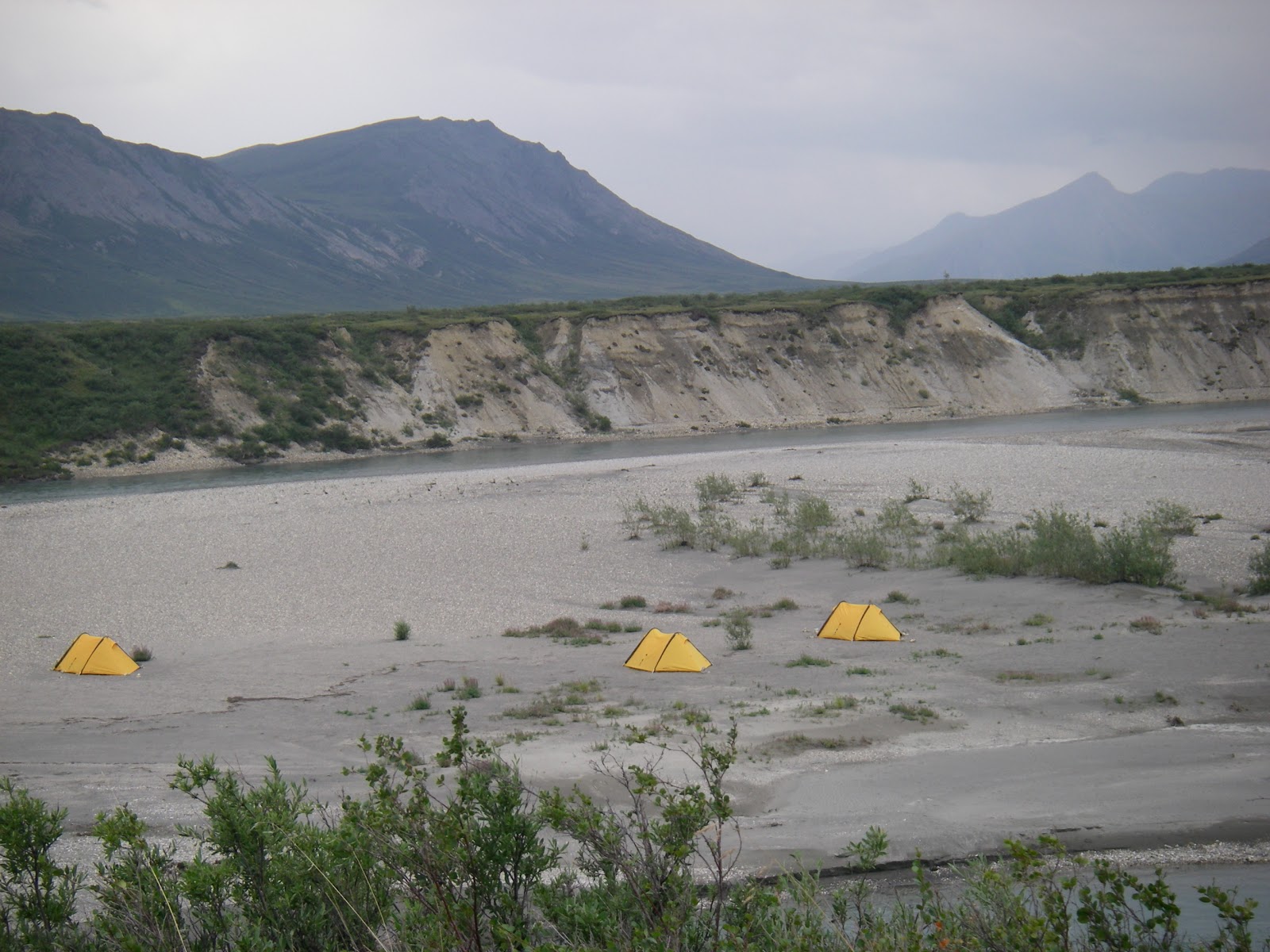
If you canoe the Noatak River, which flows through ANWR (Arctic National Wildlife Refuge), you’ll be treated to the Alaskan version of the “Leave No Trace” video. The film begins by telling you to camp on “durable ground”—that is, ground that won’t be flooded by heavy rain.  But the camp that’s pictured in the video is pitched on a gravel bar which is definitely not a “durable” surface.  Indeed, durable sites on the Noatak are a long ways from the river. Unless you are willing to haul your gear 100 plus yards up a high hill, you’ll camp on non-durable gravel close to the river.  

Here’s the recommended procedure for campfires, as given in the video:
1.    Make your campfire on gravel, close to the river.
2.    First, place a large square of plastic on top of the gravel then pile a thick layer of gravel on top of the plastic.  Build your fire on top of the gravel.
3.    Allow your campfire to burn out completely then lift the plastic and toss the ashes into the river so as to leave no trace.  Pack the plastic and keep it handy for future fires.

Okay, picture yourself doing this for every campfire you build. And who’s the lucky one who gets to pack the sooty plastic sheet that may be wet and sloppy from rain or a water-doused fire?  I doubt that any feds who canoe the Noatak do this!  Wouldn’t it be better to simply say: “Burn your fire down as much as possible, then before you leave, toss the burned remains into the river.”  Given the small amount of traffic on the Noatak, and the fact that spring rains will completely flood the gravel bars, there is little basis for this recommendation.
Camp on "durable surfaces".  This gravel bar isn't one of them.  Notice that it's nearly a quarter of a mile hike to a government-approved "durable surface".  No, the fire is not built atop a plastic sheet!

Then there’s the heavy steel food barrels that paddlers are required to carry. These “bear barrels” are not waterproof and they don’t have carrying handles or grab loops. They are awkward, slippery, cold to the touch and they roll around. There is no way to portage them, save for throwing them up on your shoulder, pirate style. Two barrels at most, will fit in a 17-foot canoe and each barrel will nearly fill the space between the yoke and closest thwart. I admire those who will tote these heavy, food-filled metal barrels 100+ yards up a hill to a “durable surface” campsite.
Another example of camping on a "non-durable" surface

Federal authorities mean well and they try to do the right thing.  Indeed, most wilderness regs make sense and should be taken seriously.  But silly “feel good” rules are quite another matter. 

Cliff Jacobson
www.cliff-jacobson.com

The lakes are calling and I must go!


I always dreamed of living somewhere close to water.  Close to lakes, to be precise because I grew up near the Rock River in Oregon, Illinois.  Back home I would ride my bike over to the Honey Creek on gravel roads that meandered into town the long way; the back way.  I could sit there, when I got the chance, for hours watching a bobber or flipping a Mepps spinner over and over again.  Occasionally Dad and I would park our car near the dam in town, walk down the bank and stand on the rocks to cast for walleye in the rushing water.

We swam in the town pool with enough chlorine to turn your hair green on long summer days.  Those days only made me long for a country of lakes even more.  Just to be able to sit by one.  To cast a line when I wanted, to jump in when it got too hot.  To listen to its songs after the darkness fell.

My dream wasn't huge… I didn't have to own property on a lake or a second home/cabin with my own beach.  I just wanted to be nearer to water than I was.  Preferably water that didn't have its own perfume of "river".  

For many people, Ely, Minnesota is the personification of that dream.  When they think of such a place as I did during my childhood, they ultimately see a green sign with only three letters: "ELY".

As I grew older I thought about how great it would be to leave work at the end of the day and go fishing somewhere.  To grab a canoe and just go.  In my mind I saw only water and endless possibilities.  That was my Ely.  More lakes than I knew what to do with.

Somehow I made it here and began life all over again as a husband and then a new father and life itself got busier and busier.  The dream stayed alive, but now that I was living it, it changed to encompass Little League and ballet and church and friends and family and a career and traveling and art and new books and more art and antiques and hobbies and…

The lakes are calling and I must go.  Yes, it is a take off from a John Muir quote, but it is a fact.  A fact of life.  They call.  Loudly.  So now, I answer the call.

One of the most exciting things is to go to work with the knowledge that when your work day is over a canoe trip awaits.  Portage packs full, family ready, dog ready, canoes on the van, Zups Polish in the cooler, fishing rods and hammocks -- check, check.  I can hardly wait.

When I am loaded up and the afternoon sun is tattooing its mark on the back of my neck as I stretch my paddle to the campsite up ahead, then I relax and think, how lucky I am to be living my dream.

Do the Lakes call you?  We're going to make this design into a t-shirt for next year.  Look for it in a catalog coming to you in March!  Answer the call!


Friday, November 30, 2012

Free Shipping at the Boundary Waters Catalog


Use Code FREEX12 for Free Standard Shipping through Christmas Eve. Oversized item charges still apply. Lower 48 states only. Can be used multiple times with no purchase limit or minimum.

http://www.boundarywaterscatalog.com/index.htm?PROMO=FREEX12


Thursday, November 29, 2012

New Guided Boundary Waters Trip for 2013


Stargazing in the BWCA Canoe Trip

Trip Dates: September 7 – 13

Call Drew Brockett or Adam Macht 1-800-223-6565

Trip Cost: $1195 + tax

6 days paddling, 5 nights camping
First and last night hotel room in Ely

Please Note: Final payment for our guided group trips is due 30 days before the trip begins.

No where else can you see the stars and Northern Lights so clear at night than the wide open wild spaces of the Boundary Waters Canoe Area Wilderness. Our backyard is void of man-made lights and it is far from the plumes of industry that cloud and obscure the natural beauty of night's canvas. There is something ethereal, surreal about the constellations when you view them in solitude. Join us for a magical time as we track the power of the great bear and map the path of Orion's belt accompanied by the haunting backdrops of the calls of the common loon and howls of the elusive timber wolf. Imagine lying on your back on a comfortable therm-a-rest gazing at the limitless vaulted inky black ceilings brimming with stars.

Discover Cassiopeia, the Twins, Andomeda, Orion, Taurus and more. Learn how to mark Alpha Stars such as Betelgeuse and Polaris to find their different mythological shapes in the sky.

Would you like to…
- View the night sky uninhibited by light pollution?
- Learn about constellations, both where they are located in the sky and the stories behind them?
- View the Milky Way in all of its splendor?
- Have a chance to see the Northern Lights?
- Explore and fish the BWCA?
- Learn canoe camping techniques from our expert guide?
- Relax and unwind in a beautiful wilderness setting?
If you answered yes to any of these questions, our Stargazing in the BWCA trip is right for you.

Since the beginning of time, humans have been drawn to the night sky. The vastness of the universe holds instinctive intrigue. Join our 6 day 5 night Boundary Waters canoe trip to gaze upon the heavens like never before.

Our trip will take you far away from the sights and sounds of the city, into the heart of the wilderness, where our stargazing will be undisturbed by light pollution. We will leave Ely one day after a New Moon for optimum darkness. The constellations and Milky Way will pop out of the night sky like many have never seen.

Enjoy the night sky like you never have before in the quiet solitude of the BWCA. Bring the kids. This trip is sure to create memories that will last a lifetime and inspire wonder.


Wednesday, November 28, 2012

New Boundary Waters Catalog Tee Shirt Ideas

We're working on some new Tee Shirt Ideas here for next Spring's Boundary Waters Catalog.  We've done some posting on Facebook and gotten some feedback, and we wanted to do the same here.

You can click on the pictures to get a bigger view.  Let us know what you think.

Tell your friends and family to get involved here and follow our Blog,

Thank you, the staff at Piragis


Monday, November 12, 2012

BLOG 29. Thanks for The Cards and Letters!

BLOG 29. Thanks For the Cards and Letters!
by
Cliff Jacobson

Cliff: BWCA. Bell Yellowstone Solo Canoe
 Dear Friends:

On November 8, I suffered a heart attack, which doctors said rated about a 5 out of 10.  Fortunately, my wife Susie got me to the River Falls, WI hospital within 30 minutes of the event and that is what saved my life.  From River Falls, I was taken by ambulance to United hospital in St. Paul.  There, they discovered that one of my arteries was 95 percent clogged; another, 85 percent.  They put in two stents , plied me with pills and IV’s and kept me hospitalized for three days.  I was released on Saturday and am back home now, a bit bewildered but smiling. On a side note, I must say that I was very impressed with United.  Their care and treatment rates A+.
Cliff and Susie
 I am told that there may be some light heart muscle damage but not enough to slow me down.  My doctor said that, in a few weeks, I should have quite a bit more energy than before the attack.  More energy?  Susie already thinks I’m the “Energizer Bunny” so this may not be a good thing.

Segway tour, Minneapolis.  It's not a canoe but it sure is fun!
A nurse at the hospital was surprised to discover that there was nothing on my medical chart.  “When were you last in the hospital?” She asked.  “When I was 8,” said I. For 72 years I’ve been super-healthy so this set-back came as quite a shock. But there’s no fighting genetics—the men in my family have all died young from heart disease.

Tomorrow, I begin a re-hab program, which I will take very seriously.  My hope is to attain my once youthful high-school weight of 128. Ah…if I could just get back the good looks!  As I look back over the summer, and especially the late August BWCA Piragis canoe trip with Steve Johnson, I realize how lucky I am to have had this problem now, not then.
Cliff: age 22 and 128 pounds. U.S. Army Gold Rifle Team, National champions, Camp Perry, Ohio 1964.
Yes, this is an M14!
My plans are to canoe across the Everglades (about 130 miles) in January with my friends Larry Rice, Darrell Foss and Rob Kesselring.  I should be in good shape by then, better, afterwards.

In closing, a HUGE thank you to all of you who wished me well through emails cards and calls.  It has meant a lot. And my apologizes for missing some planned presentations during the week I was hospitalized. 

I’ve always stressed that “skills are more important than things”.  Now I’d like to add that good friends like you are much more important than either!

Best to you all and thank you again for your support and smiles.

Cliff

Friday, October 5, 2012

Fall Catalog Covers Anyone? Comment and vote below.

The last few weeks have provided some excellent opportunities for photos.  The autumn leaves were of outstanding color and although they've been knocked down with the recent wind, rain and snow, they were memorable indeed.  Fall is a short-lived season in the beautiful Northwoods, but it is vibrant.

We're asking your opinion on some shots we'd like to use for catalog covers next fall season.

You can visit the Online Catalog Here.

You are invited to comment on the blog comment section below this entry and vote for your favorites.

Your comments will be published the following day or after the weekend (so you are aware of why they don't appear right away).  Thank you and enjoy!  Let us know what you think.

Fall Cover Option #1
Click to view Larger Version

Fall Cover Option #2
Click to view Larger Version

Fall Cover Option #3
Click to view Larger Version

Fall Cover Option #4
Click to view Larger Version

Fall Cover Option #5
Click to view Larger Version

Fall Cover Option #6
Click to view Larger Version

Followers