Showing posts with label Tim Stouffer. Show all posts

Wednesday, May 30, 2018

Jigging for Walleye in the Boundary Waters

Jig fishing is a time-honored nearly failsafe method for fishing for Walleye in the Boundary Waters Canoe Area Wilderness. It has many different incarnations and can lead to a variety of angler modified or inspired choices when it comes to personal preference.  In short it is versatile and adaptable and requires a very limited number of parts to reach success.  I like vertical jig fishing because with a little patience and of course (luck?) the right location, you can do two things well: 1) Have Fun and 2) Catch Dinner.

Traditional “ball jigs” combine a spherical weight with a hook and when the hook is tipped with bait it is a simple combination that allows an angler to take the bait down to wherever the fish are or might be.  This combination allows one to fish the rocky shorelines, fallen trees, weed lines and shale piles by casting if they want to change the pace or tire of jigging.

Vertical jigging off the bottom allows your bail on your spinning reel to be open while you rest the line on your finger.  Walleye often nibble or have light mouthed touches (not always — there are plenty of times they suck up your jig with force) and this approach allows you to play a little line out subtly before you set the hook.  You can also close the bail and just wait for the tell-tale bobbing of the end of your rod, something that gets the blood pumping really fast.  Fishing vertical drop offs, where the depth of the lake changes dramatically is a good place to start.  Jigging near tips of points, and over top mounds or rises in the middle of lakes is a good option for jigs as well.

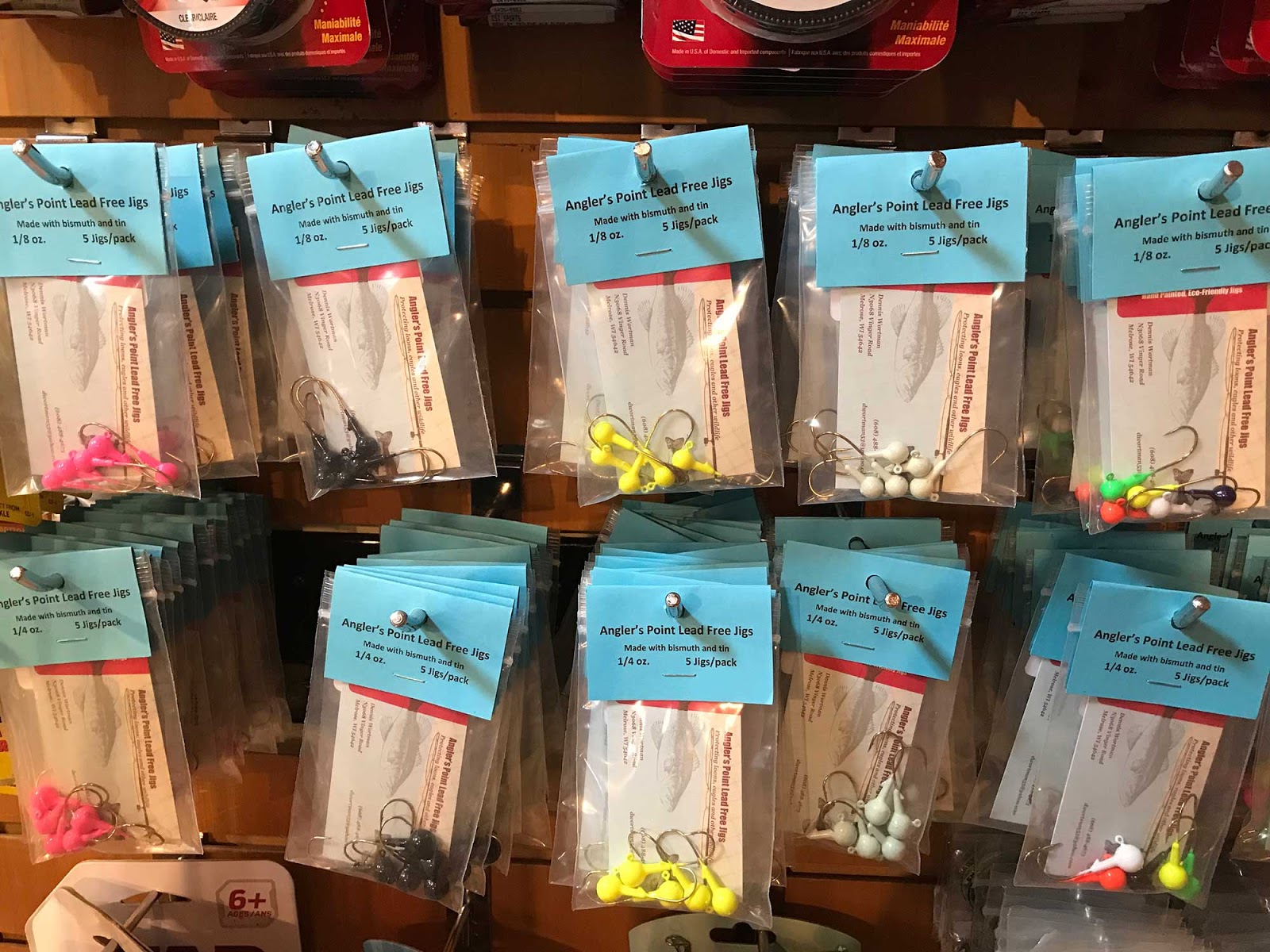


We promote non-lead alternatives in an attempt to promote Loon health.  Our state bird can easily be poisoned by lead jig heads and sinkers, as they often ingest them accidentally, mistaking them for food or rocks.  Tin and Bismuth make a slightly larger but no less effective jig.

Color choices can get you into many a long conversation with older more experienced anglers and those who are just superstitious, or rely on a favorite.  We have a variety of water colors in the Boundary Waters lakes, from crystal clear to dark and tannin stained.  It pays to have a variety of colors in your tackle box.  Many people would never try darker colors, however I’ve personally proven to myself that fish must see darker colors differently than we do because black, dark blue, red have performed well for me even in darker waters.  Traditional choices are yellow, chartreuse, pink, white or glow and orange.


The ideal choices to bait your jig hooks with are leeches, minnows and nightcrawlers.  However, live bait is increasingly difficult to keep alive during wilderness trips that extend past a couple of days or if the weather is warm such as it is in the later weeks of July and much of August. There are a number of artificial and plastic baits that mimic the visual and swimming performance of minnows, leeches and worms.  There’s even a company called of all things, Magic®, that package preserved Emerald Shiners.  These shiners are traditionally a favorite bait on some Minnesota lakes where for years and years anglers have used frozen shiners that they preserved. These preserved minnows have an anise scent to them.  Jigging up and down tipped with an Emerald Shiner seems to some to indeed be Magic.


It’s hard to beat a twister tail on the end of a jig.  White, green or black seem to do an excellent job of exciting fish and mimicking minnows, leeches and worms.


Jigs have the downfall by nature of not being weedless and hanging up on rock piles and getting stuck.  That’s why it always makes sense to take along more than you think you’ll need.  It makes sense to give yourself color options and even take along some different sized jigs in case the wind comes up (the Walleye Chop isn’t famous for no reason… they like the wind, they despise direct sunlight (look at their eyes — wouldn’t you) and they also like fast moving water (fishing the tail end of rapids often produces).  Tiny jigs and bits of Twisty Tails or colored fluff are excellent baits for crappie, trout and panfish.

I have to confess that I really enjoy bobber fishing and often I’ll employ a jig at the line underneath my bobber and just let my patience drift.  There’s nothing quite like watching that red and white ball go under, and then go deeper.  Wham!!! Dinner!

Just a side note because sometimes you want options.  When I first moved to Minnesota I came across a rig called a Winkum Spin-N-Float.  There’s a little float and a spinner attached to the same leader line as the perfect sized simple Walleye hook.  Where this rig attached to your line you attach either a sliding weight or a few of Water Gremlin Lead Alternative Sinkers.  You bait the hook with a nightcrawler or your preference and the float keeps it up off the bottom while the spinner attracts attention.  Toss is out from your campsite and leave it sit while you wait for the end of your rod to bend down!  When I’m not jigging or casting a countdown Rapala® or Mepps® spinner, I’m using one of these.


Once again, my fishing choices revolve around simple, classic choices that can appeal to a variety of species and produce time-honored results.  Walleyes in Minnesota seem to bite on vertical ball head jigs more than just about anything else.  If you don’t include Mister Twister® Tails in your pack, you should.

As one of the anglers, Mark, who replied to my last fishing blog said, “I usually paddle into the wind on a lake, and then toss one of my white twisters out and drift with the wind across the lake and usually have caught at least one northern or walleye using this method.”  You see what I mean, jigs are versatile and adaptable.  They allow you to develop your own style and catch fish the way you are most comfortable.

Thursday, May 17, 2018

Boundary Waters Fishing: Go To Lures by Tim Stouffer

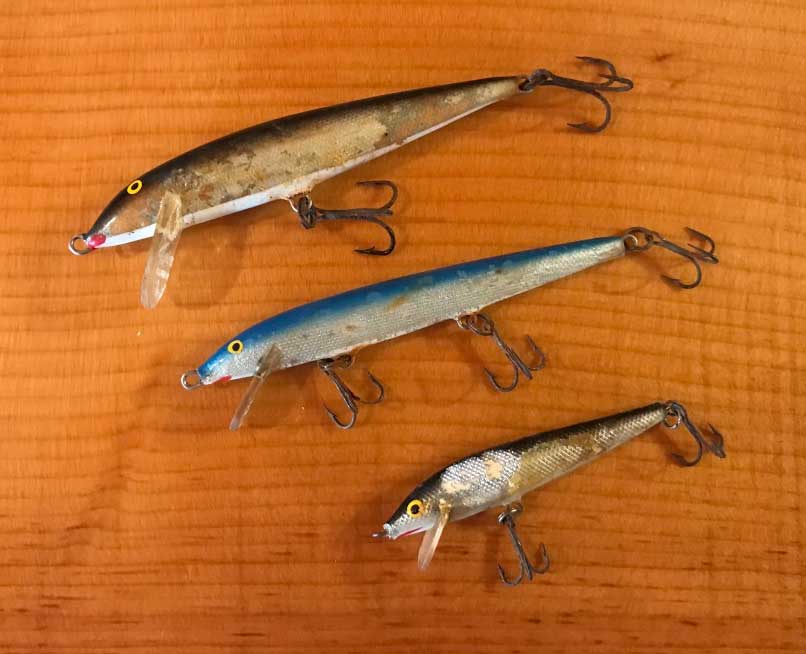
I often find Original Floating® Rapalas® in various conditions in the bottom of old tackle boxes that I buy.  Since I was a little kid, one of my passions has been antiques.  I gravitate towards old tackle boxes and (avoiding rusty hooks) love to dig through them looking for treasure.  Aside from remnants of melted plastic worms, the single most popular discovery is some form of lightweight balsa Rapala® Floating Minnow.  Sometimes this will include foil-sided early models with embossed stars from when they were still made in Finland.


This got me to thinking… why do I find so many of these?  Why are they always in such a state of disrepair and not pristine?  Why do their newer counterparts show up nearly as often in Perch, Silver and Blue, Firetiger and Orange?  And, perhaps an even better question, what do I consider my “Go To” lure when on a Boundary Waters Canoe Trip?  Not necessarily my favorite lure, because if I’m perfectly honest Mepps® Spinners are my favorite because they were my Dad’s favorite and who doesn’t enjoy a bit of flash?  Usually walleye, definitely Pike and the Smallmouth love em.  Let’s face it though, they aren’t minnow shaped, don’t swim or look like a minnow except in the heat of the moment.


Most predators are attracted to anything that closely mimics their natural prey.  Wounded or erratically swimming minnows.  Or, when wounded ones aren’t on your radar, something that looks like what you’d expect to be swimming in the water.

Live bait is difficult to keep alive during the Summer months when the temperatures rise.  It’s hard to transport and care for even when it is cooler outside.  Most of us use artificial baits on extended trips longer than a couple of days.  Most anglers have favorite colors and like to change it up according to the season.  I prefer perch colors early and late in the year and will switch them out for Firetiger and Silver and Blue and crawdad brown and orange imitators during the heat of July and August.

Whether or not I’m going up to Quetico Park in Canada where barbless hooks are a requirement, I always pinch the barbs of my hooks off.  Often on a Rapala® that means crimping down 9 hooks for the three trebles, at least six, depending upon the model.  Fish tend to flip and writhe at the exact moment you are reaching into the net or for their mouths.  At that point you are in danger of embedding multiple hooks into your hand or arm and believe me you don’t want that to happen.  You especially don’t want those hooks to have barbs on them when they are driven deep into your thumb.

From the beginning Rapala® has tank tested and tuned by hand each of the lures that they produce.  This is how you know that every model you pull of a new box or old tackle box will accurately mimic the action of baitfish.  There are many different models available and I plan on highlighting a few of our favorites that produce well in the Boundary Waters.  You can plan your wilderness tackle box accordingly and tweak what you take along in your canoe to your taste.


Shallow Fishing for Northern Pike, Walleye, Bass and Trout is an ideal beginning to the season.  For this the Original Floating® Minnow is very hard to beat.  Fish where you know baitfish will be: in warmer waters, near new weed growth just underneath, casting near structure like downed trees and shallow rocks.  Add weight like a pinch on sinker of some sort (we recommend non-lead alternatives because lead poisons Loons and other wildlife) perhaps a foot above your Original Floating® Minnow and you’ve just extended the season and reason for this lure.  Now you can troll at mid-depth with it.


If you like to hunt for large fish, you can use Husky Magnum® or Floating Magnum® Rapalas both as floating surface models as the Lilly Pads and grasses grow out of the water or off of a “bottom bouncer” a weighted wire that bounces off the bottom and allows you to fish large lures way down deep.  This is a classic up north way to troll deeper waters but requires heavier rods, reels, line and leaders.  The point is, as you are starting to imagine, that Rapala® makes a lot of lures, but each one has multiple uses!


While we’re on the subject of Big, one of our Outfitting Crew’s favorite lures is the Deep Tail Dancer®.  Made to head down to the thirty foot range they seem to attract a great deal of attention from Lake Trout and larger fish in particular.  They come in some fantastic color options.  They’re a little bit like an overgrown version of the Fat Rap®, which has also been a favorite of Walleye and Pike for many years.


The CountDown® Rapalas® are the best choice for mid-range depth and they lend themselves to great stop-and-go motion when retrieving.  One of my most successful afternoons of Walleye fishing involved casting medium sized Perch colored CountDown® Raps towards an island and counting to five before I began retrieving it in a steady, fluid motion instead of stop-and-go.  I couldn’t cast it too close to the island because by the time I reached five, it would have sunk to snag in the rocks, but with patience in my pocket by the time I reached another five on the retrieve I had a Walleye on.  Time and time again, the perfect size for dinner, one after another.  Ever since then, especially on a hot day, I’ll go back to the CountDown®.


Anytime during the season when you want to get attention quickly, it’s a good idea to move to the erratic swimming motion of a Jointed Rapala.  Your retrieve and depth choices can modify the display of this magical lure even more.  Wounded Baitfish, wounded baitfish, wounded baitfish.  It should be your mantra, especially when nothing else is working.  If you are paddling steadily towards your first (or next) campsite and you want a lazy way to have the best chance at fresh fish for dinner, the Jointed Rapala is often your best bet.


Around camp, you’ll often find panfish.  Usually that also means there’s Northern Pike, the wolves of the northern waters, cruising for big punkinseed and bluegill (not to mention Black Crappie).  Traditional ways to fish for panfish include slip bobbers and tiny “flu-flu” jigs.  I like to put on a piece of night crawler when I’m near home. People love to fish them with a slip bobber rig and small, silvery “crappie minnows”.  Those traditional methods involve live bait. There’s a relatively new version of the fantastic performing Fat Rap called simply the Mini Fat Rap.  They have a compact, tight swimming action that imitates (nearly perfectly) the speed and motion of a fleeing baitfish.  This causes what seem to be instinctive strikes from panfish that you’d expect from its one and a half inch size.  Again, add a weight six to twelve inches up from it on your line and you can create this action at a deeper level, down by where the bigger ones are hiding in the shadows.

Well, that’s why you find so many Rapalas® in old and new tackle boxes up North.  Down South too, for that matter, but for the Boundary Waters and Canoe Camping Trips, it’s hard to beat a balsa minnow that has been hand tuned to catch fish for dinner.  Breakfast too.

You pick the colors, you pick the style, just get more than one, because even if you don’t lose any, your friends will want to use em.  These lures and/or other Rapala® lures are in-stock at our Retail Store, Piragis Northwoods Company at 105 North Central Avenue in Ely, Minnesota on the edge of the Boundary Waters.

Thursday, April 19, 2018

Poem: Minnow Bay by Tim Stouffer


Minnow Bay

Ahead, light pours out over water so clear
that every rock is bathed in sunlight;
afternoon’s gift of warmth 
to native Minnesota minnows:
Bluntnose, Creek Chub, Fathead, Golden Shiner
and Northern Redbelly Dace.
Minnows, not just smallish fish.

Like abandoned  jewels encrusting the bottom,
their scales capturing shadows bouncing
from agate, quartz and granite gravel.

Pushing off the canoe with my foot in the cold water,
I don’t drag, don’t bang, don’t make a sound,
yet they scatter in schools from the over-large shadow
of the craft, giant and banana-like above,
my second summer skin,
gliding out of the bay.

How can these waters still be so clear?
How can silence still be the musical score?
How have you waited so long?

Underneath, untouched by travelers,
another world reflected.

Another chance at
freedom.

©Timothy James Stouffer 04182018
All Rights Reserved Ely, Minnesota

If you are looking for a kevlar canoe for the Boundary Waters and Beyond,
click here for our fantastic selection of canoes (tandems only way 44 lbs)


Friday, June 9, 2017

Moments in Polaroids: Lines from the Boundary Waters and Beyond


Moments in Polaroids

Remember when you’d stand there
shaking the film as it developed from a grey
ghost slipping through the shadow world,
like a walleye
rising up through
tannin stained waters,
desperate to stay
hidden but
pulled uncontrollably
towards the surface that
tensioned between
you and I.


Little by little the granular
surface would appear
underneath colors
that couldn’t quite
be explained. Then we’d
shove our eye into
that rubber socketed
viewfinder again and
shift the sun to the
left while crossing
our fingers. While missing
the larger, contagious
beauty?


If only this touches
the memory of this moment
just a fraction, sets the hook,
I can reel in the rest of
it years from
now when we dig
through a dusty box
forgotten in the attic.


Remember when we spent
more time making the
memory than recording it?

Let’s do that again.
Let’s do
that now.


©Timothy James Stouffer 06082017
All Rights Reserved Ely, Minnesota

Wednesday, June 7, 2017

Father's Day Special Blade from Helle: Godbit

Each year the good folks at Helle Knives release a special edition model for Father's Day.  This year their knife is the Godbit.

HAPPY FATHER's DAY!

This year's model is the "Godbit" which means "goodie" or "treat".  This model was originally produced in the 1990s and was designed by Gunnar Lothe. The pommel knob on the end anchors the knife in place by securing the knife via the sheath tab (similar to the Helle Harding model).

Handle : Curly birch, 4.53 inches long
Blade : Triple layer steel, 4 inches long
Includes: Genuine leather black sheath
Total weight : 6.07 ounces


WE CURRENTLY HAVE THE GODBIT on SALE  Was $144

Now $129.99

Click the image below to purchase at the Boundary Waters Catalog!


Poem: Grandparents Lines from the Boundary Waters and Beyond


Grandparents
(Poetry from the Boundary Waters and Beyond)

This day ending with its sentinels
of pine pointing towards the
setting sun could have
meant anything,
anywhere,
to
anyone.

But,
to you and
I under the tarp near
the glowing coals of the fire,
it meant sore muscles, blistered
hands and one of the best tasting
dinners I've eaten out of a
pouch in forever.
Well, what
wouldn't
taste

Fabulous
when paired with
lake trout picked up while
trolling towards this point on
the island that gifted us a view of
our own private lake?  This
moment is why I wish
I would have
listened
to you
be

fore, when you told me that we could still find ourselves in the boundary waters canoe area wilderness, even at our age, even having forgotten more about camping than most young people ever imagined they'd learn thank goodness for the air mattress and the forty four pound kevlar canoe.

It is never too late
to remember.

©Timothy James Stouffer 05252017
All Rights Reserved Ely, MN

Monday, May 15, 2017

Mother's Day and Fishing Opener -- Adventures in Ely

This past weekend were two of my favorite days of the year.  For once, Saturday, came without snow, without hail, without a blustery windy, rainy day that was more about what rain gear to put on that would allow for multiple warm layers underneath than fishing. It was a pleasant day. So of course, that meant that I ultimately had other plans.

One of my fishing partners had to travel to Virginia, Minnesota mid-day to finish up her last hour of behind-the-wheel-driving so that she can take her driver's test as close to five minutes after she turns sixteen as possible.  My oldest daughter is all about fishing, just like her mother.  Her younger sister is also one of those people who will sit in a canoe or ankle deep in water for hours as long as they are biting.

Sure I had a couple of friends that had asked me to hit the water for opener, but I'd promised Lucy that I'd fish first with her, and so, I took the day to work on my novel.  Writing went well enough and all and all it was a relaxing day in which I solved some problems, gained some ground on character development and discovered something I'd been hoping to find.

That evening we went to an early graduation party for one of my son's friends and the next morning was church.  After that Lucy, Juliet and I changed clothes, loaded up the gear and canoe, stopped at the bait store for supplies and headed out.  We needed to be back before five to get started on dinner for Mother's Day.

The sun was out and there was a breeze that pushed us around a little bit, but most often let us be.  The water isn't very warm due to quite a few nights in the twenties, but it isn't just a few degrees above freezing any longer either.  We had sustained ourselves with a quick lunch just before leaving and I have to admit that with the warmth of the sun on my face I was perfectly comfortable just lounging in the stern seat of our Wenonah Champlain.


We had our lines out and the girls spent time between bites to add laughter to the lake.  For some reason Lucy and I repeatedly over cast nearly every time we threw towards the shore.  Probably over zealous after a long winter :) and so we ended up tangled in a few branches and bushes.  That only contributed to the hilarity.  It didn't take long though for her to land the first fish of the season.  On Mother's Day.

Well before that I felt like I'd achieved my goals.  Sitting there in the canoe, peering down through clear water, I felt like Spring had finally arrived.  With the sound of strong wings beating the air a wood duck landed on a house attached to a dead spire of cedar rising up out the lake bottom about 6 feet from my end of the canoe.  She disappeared inside and it was about that time that we too, felt the pull towards home and dinner and the celebration of MOM.

I pulled up that anchor, we stowed our lures, hooks, and rods and put our paddles to water.  Pulling through the cold water it was hard to imagine that just a little while ago we'd have been walking out here.  Up ahead though, shot up two of the clearest signs that the season had changed for good... a pair of loons surfaced, stark white markings against black so deep in color that it takes on purple and green coloring.  Sleek, young, streamlined.  Up close, only a few feet from the canoe, I'm taken with just how beautiful they are each time I see them.  One after the other, they dove underneath the surface and with powerful kicks from their legs glided past.  Every detail was visible in the clear water and their white spots seemed to glow until they surfaced again twenty yards away.

I wanted to stay, but the blackflies had arrived as well, and so we climbed out, grabbed everything and Lucy took off down the trail with the canoe on her shoulders.  Just like when Simon was a very little boy, Juliet now voiced what always comes to mind.  Walking behind, it looked like Lucy wore a giant yellow hat.

Olive bread and barbecued chicken awaited and the giving and receiving of gifts for the two moms in my life.  My wife and my mom.  As Simon would later post, "GOAT" -- the Greatest Of All Time!


Happy Mothers Day to all you moms and Guys, if you spent all weekend fishing, you missed out.

Peace, Tim Stouffer, Piragis Northwoods Company.

Friday, May 5, 2017

What does Hegman Lake look like in the Winter?

Have you ever wanted to walk on water?  Visit the pictographs on a windswept day?  Or perhaps you've just wondered what the northland looked like during winter.  We visited one of our favorite (and many of yours) places this winter.

We thought you'd like to see Hegman Lake in March.

If there are other places you'd like to see or things you wonder about around the Ely area and our favorite wilderness, please comment below and let us know.


Wednesday, May 3, 2017

Poem Silhouetted by Timothy James Stouffer


Silhouetted

Against the last of Winter’s 
remnant, pines strike
a pose familiar.  When 
the skies wouldn’t stop
weeping but couldn’t
agree on flakes or tears,
the sun, brief and frustrated,
settled the matter.

A signature on that first
day of May that fleeting
formed a question mark
in the second morning
and inquiried of us all.  What
do we think
the shadows keep?
Who might the 
light reveal with
its brush under the boughs?

Sifting through the slush
of sunrise, my fingers grow
cold and numb
searching by feel in the thick darkness
for the words to our song
that began with Spring
but has lost itself
against the reflection
of the reaching
Red Pines.

Where is it that the path
leads us two from here?
Like some darkened maw
swallowing the borders
marked so carefully
on the map we hold.

©Timothy James Stouffer 05/02/2017

All Rights Reserved Ely, Minnesota


Thursday, April 27, 2017

Glamping with Mary Jane Review

Glamping :)  Glamping with Mary Jane by Mary Jane Butters

At first glance this book looks like a cross between a pin-up poster review and a vintage R.V. advertisement.  Glamour camping has much more to offer as a concept, though.  We sell lightweight gear and canoes for the Boundary Waters and Beyond.  Our bookstore is eclectic!! Our philosophy is not a purist exclusive.  We figure, if "IT" gets you into the woods, then IT is a good thing.  Isn't IT?


Mary Jane Butters has an affinity for the vintage paired with modern sensibilities.  As an antique collector and dealer, I can certainly appreciate her point of view.  She begins with a short history of women in the outdoors and jumps right into trailer shopping and restoration.  M.J. makes it clear that research and more research is key to acquiring and outfitting a new mobile version of your home away from wherever you used to have to be to lay your head on your pillow at night.


Tenting, outdoor bathing, adjusting to small spaces, decorating, ideas, lifestyle, gear, tool kits, safety, maps and more are the waypoints in this GPS of a camping book.  Inevitably leading to some fabulous recipes, which is, lets face it, is the key to what most of us think about when camping or Glamping... Good Food.

And... how to cook it over a campfire.


Activities follow, including Junktiquing and other distractions and excuses to hit the road.  Who doesn't want to reclaim some items from the past and give them your own flair and flavor n'route to the next International Glamping Weekend?


You might find yourself wondering why this book is on our list and so I'll repeat myself.  If reading it gets you outside and sleeping under the stars then you are one step closer to braving the wilds of the Boundary Waters.  And... one step closer to a visit to the Canoe Capital of the World... Ely, Minnesota.  Besides that, I like the restoration of old things, even trailers, and, I like the restoration of some old ways of thinking.

Namely that camping can be an eventful lifestyle - a celebration - at all levels instead of a difficult endurance exercise.  Roughing IT has its place, but being comfortable and happy outdoors is never overrated.

One more thing.  The book is fun.

Tim Stouffer
the Boundary Waters Catalog


Wednesday, April 26, 2017

Keep your eyes Peeled

Lee Johnson is the Heritage Program Manager for the Superior National Forest.  He's also a friend of ours who at one time worked with us here at Piragis.  He recently gave a talk here in town at the Grand Ely Lodge during one of our Tuesday Group meetings.


These meetings take place every Tuesday over the lunch hour and everyone who's interested are welcome to come. We have guest speakers and the subjects vary from who's newly moved to town and their personal introductions, to antique history and appraisals, to natural history and preservation to Ely area current events, to politics, to... well you name it.  It is great way to have lunch with others and connect and to learn about many things in person, that you probably have some connection with, but don't know too much about.

Lee was working on a project in the forest that is about to have the results published.  Travelers and members of the Forest Service have begin to discover what Native American canoe builders knew already existed.  Bark-Peeled Pine that dot the Border Lakes Region of Minnesota and Ontario.  What made these marks and why?  That was the topic of the study and the talk.

These are not the triangular fire scars that are widest at ground level, these are usually head or chest high and terminate at waist or knee level.  They profile deep tree wounds with large "healing lobes" and are most often present on Red Pines, though also on Jack Pines and occasional White Pines.  The theory presented by Lee was very interesting and rather easy to subscribe to based on the discovery and historical documentation that he provided. Native Americans most likely made these marks to collect Pitch for Gum that was used to build and repair birchbark canoes.  This pitch and gum was an integral part of the fur trade era.  Indeed, without it, your canoe would begin to fall apart and sink.

These Bark Peeled Pines are clues to the glue that held the culture of the fur-trade together and date back to the mid-18th century.  Each year we lose some of these ancient trees to age and storms, so preservation of these uncovered stories may depend on written record alone as time goes on.  It was a fascinating presentation and I've duplicated the brochure here for you:


If Birchbark Canoes interest you, you will enjoy Bark Canoes and Skin Boats of North America by Edwin Tappan Adney and Howard Chapelle with a forward by John McPhee.  Lee referenced it several times during his presentation and it has been a perennial best seller for us since we began incorporating great books into our retail store in 1979.  An interesting read and a fantastic resource.


Friday, April 21, 2017

Book of the Week Manitou Canyon by William Kent Krueger

I like the Cork O'Connor series of mystery books by William Kent Krueger quite a bit.  More importantly, for myself, I like Krueger quite a bit.  I've met him twice, both times in Ely.  He's been here at Piragis for a book signing and reading and he's been to our new Ely Library.  At the time of his last visit Manitou Canyon was about to be released and I got my hands on an advanced reader's copy.  It didn't disappoint.

 Buy Here


Everyone loves a good car chase in a movie and Krueger delivers on some great canoe chases in the wilderness.  There's something about a wilderness mystery that includes danger from humans that moves the story even more fluidly forward (and sideways) through an already wild environment.  Add in the unknown approach of Winter's grip and after just a few pages (paragraphs really) the reader wishes they had the whole day to spend in the midst of this story.

Perhaps the real reason that William Kent Krueger finds his novels on the New York Times Bestsellers list is because he naturally slips in between the pages of his stories.  Ordinary Grace won the Edgar Award for Best Novel and many think this stand alone book holds some of his greatest work.  Fans of the world that Cork finds himself in, the land of the Superior National Forest, Boundary Waters and Beyond, though, find themselves connected in very personal ways to Krueger's cast of characters.  His unabashed efforts to incorporate social problems that face us all but women and Native Americans in particular deliver a punch to our reality gut that can't be ignored. This writer takes the time to know the land and the people he writes about.  The fact that these stories are woven into the fabric of our own backyard makes our paths cross in ways that other books can't.  We find ourselves walking and paddling the same routes, capturing the same sights and smells around the campfire with O'Connor.

In person he is generous with his time (he's taken a few minutes each time I've met him to discuss with me the pages of my own novel in the works).  He is engaging and honest about his path to success and the power of story.  He's also committed to the story itself.  Oh, and he's generous with his time.  Yes, I repeated that because I would encourage you to attend a reading and signing if he is scheduled to appear in a local bookstore near you.  The talk and question and answer sessions are worth the time!

If you've been looking for a good series that won't fail to entertain, don't miss out on Krueger, he won't let you down.  And... you don't have to start at the beginning.  Give Manitou Canyon a try!

"Manitou Canyon 
by William Kent Krueger
Since the violent deaths of his wife, father, and best friend all occurred in previous Novembers, Cork O’Connor has always considered it to be the cruelest of months. Yet, his daughter has chosen this dismal time of year in which to marry, and Cork is understandably uneasy.

His concern comes to a head when a man camping in Minnesota’s Boundary Waters Canoe Area Wilderness goes missing. As the official search ends with no recovery in sight, Cork is asked by the man’s family to stay on the case. Although the wedding is fast approaching and the weather looks threatening, he accepts and returns to that vast wilderness on his own."

Tuesday, April 18, 2017

North Shore Road Trip

Monday was a day off for Easter break for my kids and so we hit the road.  Jen and the girls headed one direction and Simon and I headed into the wind, for the North Shore of Lake Superior.  Down Highway One out of Ely, into the teeth of an April "snowstorm".  The flakes were huge and the further we drove, the more evidence of snow could be seen on the branches of the pines and forest floor.  It was April, though, so 95 percent of it wasn't destined to last the hour, let alone, the day.

We turned off of Highway One and onto Two on our way towards Two Harbors.  Easy on the directions, easy on the eyes.  We stopped at two points of interest on our way through the forest and the surrounding lowlands.  One was a little public access to a roadside lake and one was a forest service picnic area.


This particular spot has a sign titled, "Sentinels of the Past" and shares the fact that these old White Pines were already 70 years old when the Declaration of Independence was signed in 1776.  Standing under them, with the last evidence of of winter desperately clinging to their branches I couldn't help but notice a chill running up my spine.  They are survivors and they are a constant reminder that the forest around us is a living, breathing organism.  It isn't simply a place to enjoy, it is, very much so, a part of our home that has a much longer history than we do.

How many have stood under these trees?  How many have stood there with their sons who are now men and are making preparations for college.  What kind of lessons could be learned with time enough to sit on a fallen pine that has been in this place for 300 years or more?  It was a quiet morning under the clouds and a perfect beginning to our road trip.

Ely is a great spot to visit and to kick off your Boundary Waters Canoe Area Wilderness trips.  It has a lot to offer, including spending time around town and our area before and/or after your canoe trips.  The North Shore is less than two hours of driving that could include multiple wildlife sitings like moose and more!  Our bookstore manager, Jordyn, saw a moose the day before we drove down Highway One and so did Drew Brockett, our canoe trip outfitting manager.  Here's a shot of the one he saw on Sunday.


We continued our trip, down to Two Harbors and took a left to check out how the waters of Gitche Gumee were breaking against the shore and the Split Rock Lighthouse.  Driving through massive tunnels in the granite, pulling over at various rivers and rest stops, listening to music on the winding road.  Everything combined for a fantastic soundtrack to the best movie I've seen in years, right through the windows of the Mountaineer.  Best of all, whenever we wanted, we could park and walk right into the environment all around us.

The black sandy beach filled with battered and softened rocks and driftwood, the bike paths, the cold spray in our faces and the snowflakes that were by this time fading in their strength, these things woke me up to the beauty of Spring and the ice-out season.

We turned around at some point and headed to Duluth for lunch.  Afterwards, we returned by the Scenic North Shore route and stopped to experience anything that caught our eyes.  The sun had come out and the blue of the sky was now reflected in the big waters of our inland sea.

It was hard to leave...


Thursday, April 13, 2017

A Walk in the Woods


The green city population sign near the David Dill Taconite Trail on Highway One, doesn’t tell the whole story.  First, Ely’s population seems to ebb and flow with the seasons and because the snowbirds leave before the white stuff arrives and return after it leaves our waistline grows after the ice retreats.  Second, on the edge of town, in the middle of town, and definitely in the Superior National Forest that surrounds our little hamlet, wildlife is abundant and surprisingly not too shy.

We’ve seen lynx in town, deer on a regular basis, wolves on the outer streets, small mammals (or smammals) are commonplace.  I’m sure at some point in the not to distant past a moose or two has sauntered across the city lines.  On our honeymoon, my wife and I were shopping at what was then Hill’s Wilderness Canoe Outfitters and a yearling black bear sidled right into the side door and raised himself up on a rack of paddling shirts.  Jen turned to the cashier and asked, “Does he shop here often?”

We share this space with those of four feet, not to mention the wide variety of avian neighbors that we have.  It is one of the things that makes Ely and the Boundary Waters a wonderful place to call home.  

The Taconite Trail knifes through the edge of Ely and bisects both Highway One and Highway 21 on the other side.  It is trafficked most during winter months as a snowmobile trail and as I walked it last night, it sported ATV tracks.  At this time of year about half of it is dry, a quarter is soft and another quarter is wet.  The wet parts vary from ankle deep or deeper water that is pure ice melt and about 39 degrees to liquid mud.  I wore running shoes and broke through ice several times to fill them with water.


Early spring in Ely always holds on to snow and ice patches in the woods mostly due the protective shade from the trees.  Unless a trail is wide and on high ground and doesn’t have tall trees overhead, snow and ice will prevail for weeks to come.  We’re still dropping down into the low thirties and high twenties at night and have yet to climb steadily out of the mid fifties during the day.

The Taconite is a rolling up and down walk for much of its course and meanders through a variety of woodland trees dotted with granite outcroppings and a few wide open meadow spaces.  Towards the edge of the city limits over by Highway One, the trail intersects the burn area from a couple of years ago when a power line fell and ignited a fire that threatened to advance to homes.  In the end that fire was responsible for taking out one or two outbuildings on private property, but no homes.  Through a timely, skilled and valiant effort, Ely was saved by fire fighters and fire fighter pilots!

I was walking hard, exercising, for most of the trail, but I did take some time to smell the roses or swamp fringes as it were.  And.  Time. To. Listen.  The birds were out enjoying the extended sunlight.  I heard distinctly a powerful stamping of a large dear, probably a doe, but because everything around was a dull mud brown, I couldn’t spot her amidst the red of the ash saplings and the brown of the red pine trunks.  The hummocks of grass hid the few frogs that called out with high reaching belches of sounds so close to the small bird calls that it was hard to tell them apart.  The robins were back.  Two days before on the same trail, Jen spotted a secretive beaver.

I wished at this point that I'd brought along a book that my boss, Steve Piragis, just reviewed.  Lost Among the Birds.  It'd be a relaxing cap to the evening to sit and read while the sun went down, but it was getting colder and I needed to move on.


I discovered a couple of piles of wolf scat.  From then on I felt (no, not followed) but at home.  Like I’d made it far enough into the wild to enjoy the new sun on my back and the sounds of nature all around, that didn’t include civilization powered chainsaws, cars or music.  The music up ahead was some of the most beautiful and original ever heard.  Never the same score, always a new melody with running water.  Water flowing over root and rock.  In this case water that had carved out a valley for itself under a frozen patch of snow.


It was the kind of place I’d have liked to stay for hours as a kid.  Floating leaf boats and twigs through the tunnel and out into the wetlandish lowland marsh on the other side.  It would be a good place to sit and journal or appreciate the sunset.  I left it after a brief respite knowing that the next time I walked this trail it would be transformed into just another muddy patch across my path.

There are places in the world where everything comes close to staying the same.  Ely isn’t one of them.  Here we are always in flux.  “If you don’t like the weather,” my Grandfather used to say, “wait a moment.” (and you might not like that either)  Northern Minnesota keeps things interesting.  Which is one of the reasons there’s always something new the locals are talking about when you arrive to visit. 

What happens when you escape to the wilder areas though, still remains the same, though varied in our perception and experience.  Just a few steps or paddle strokes away from everyone else it is inevitable that you will find a freedom of spirit, a lightening of your load as stress is lifted off your shoulders.  Truth.  Sometimes it is replaced by a heavy portage pack, but that is a burden we gladly take upon ourselves.  One that makes each day more fulfilling when we slip it off at the end of the day or part way down the trail to lean upon and reflect how real this all is, and how it is worth protecting no matter the cost.

That’s where my trail took me, where does yours lead?


Followers