Wednesday, May 22, 2013

Boundary Waters Fishing Gear List by Piragis Northwoods Company

Boundary Waters Fishing Gear List

We get asked all the time what our choices for fishing trips in the Boundary Waters are. While what goes in a guy's or gal's tackle box can be very personal and lures are highly prized for sentimental and experiential reasons… there are tried and true options that have advantages over others.

There are a "big three" of fish species in the Boundary Waters, four if you include Lake Trout, although they are not as prevalent. Walleye, Northern Pike and Smallmouth Bass can be found throughout the Boundary Waters (BWCA). Panfish such as Black Crappie and Bluegill are common as well. We'll focus on the "big three" for the purpose of this discussion. Please note: All of the items discussed can be purchased in our retail store at the first stoplight in Ely, Minnesota before your trip begins. At Piragis, we don't run out, we keep these staples in stock, in the best color and size combinations.

The first thing you need is a good Medium 2 piece spinning rod and one for back-up. If you want to go with a slightly heavier action on the back-up rod, that is fine. Extra line, pre-spooled is a good idea. The best choice for the BWCA is 8 pound test. We advise you take something 6 to 10 lb. test, nothing lighter unless your passion is ultra-light fishing and then you'll have to adjust a great many of the lure choices that follow accordingly.  We carry an excellent and quite affordable break down pack rod and a case made right here in Ely that fits each piece and rolls up to protect it in your pack. That little detail can allow you to have a rod in your pack without hardly noticing it.

Smallmouth Bass and Northern Pike like surface lures. Frog baits, Mouse baits and floating Rapalas always top these lists. Old standards such as Lucky 13, Tiny Torpedo, Bass-Oreno and the newer Pop-R baits all pull Smallies out of their hiding places. Smallmouth Bass like the durable plastic baits such as Zulus and Zooms and others that mimic dying minnows. These are best rigged simply with a large "worm" hook and retrieved like a wounded minnow would swim.
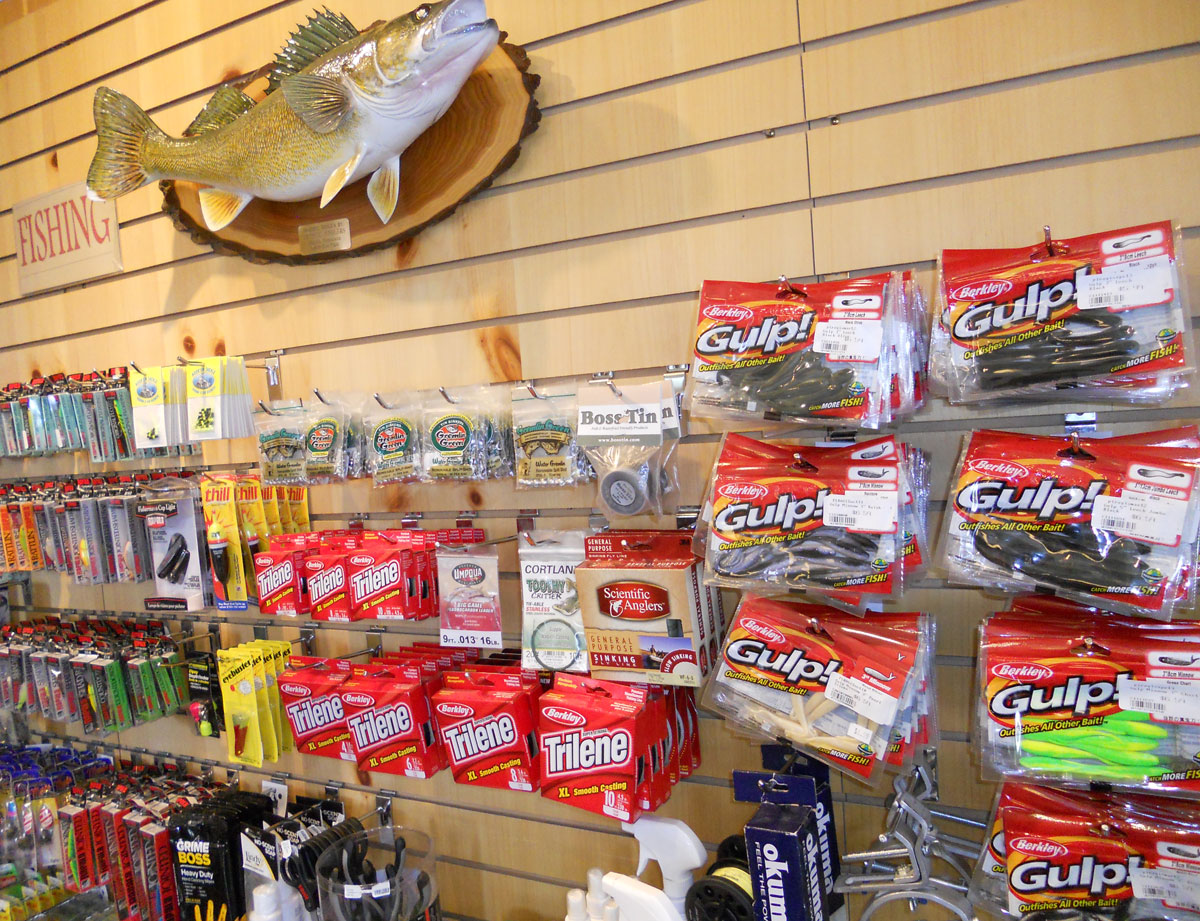


Crank Baits come in various combinations of diving depth. Rapala has shallow and deep runners, ranging from baits that run three to nine feet deep. These are all good and work while you cast or troll for dinner as you paddle through paradise. Shad Raps, Rattletraps and lures like Crawfish Baits and the Wally Diver are fantastic choices to attract Walleyes. It is a good idea to have a combination of all of these to choose from. Tiny alternatives like countdowns and large and jointed Rapalas give you some great options during the heat of Summer.


We stock and carry non-lead jig heads in 1/8 oz and 1/4 oz in a variety of highly visible colors. These work great with live bait (minnows, leaches, night crawlers) as well as Gulp artificial versions of those three. Jigs work well with Twister Tails in bright colors and black as well. Those combinations are some favorites of Walleyes in the Northwoods.

Daredevle Spoons in silver, gold and the old standby, red and white are hard to beat when you want to troll deeper with some flash. Fish just respond to them and always have, especially big fish.
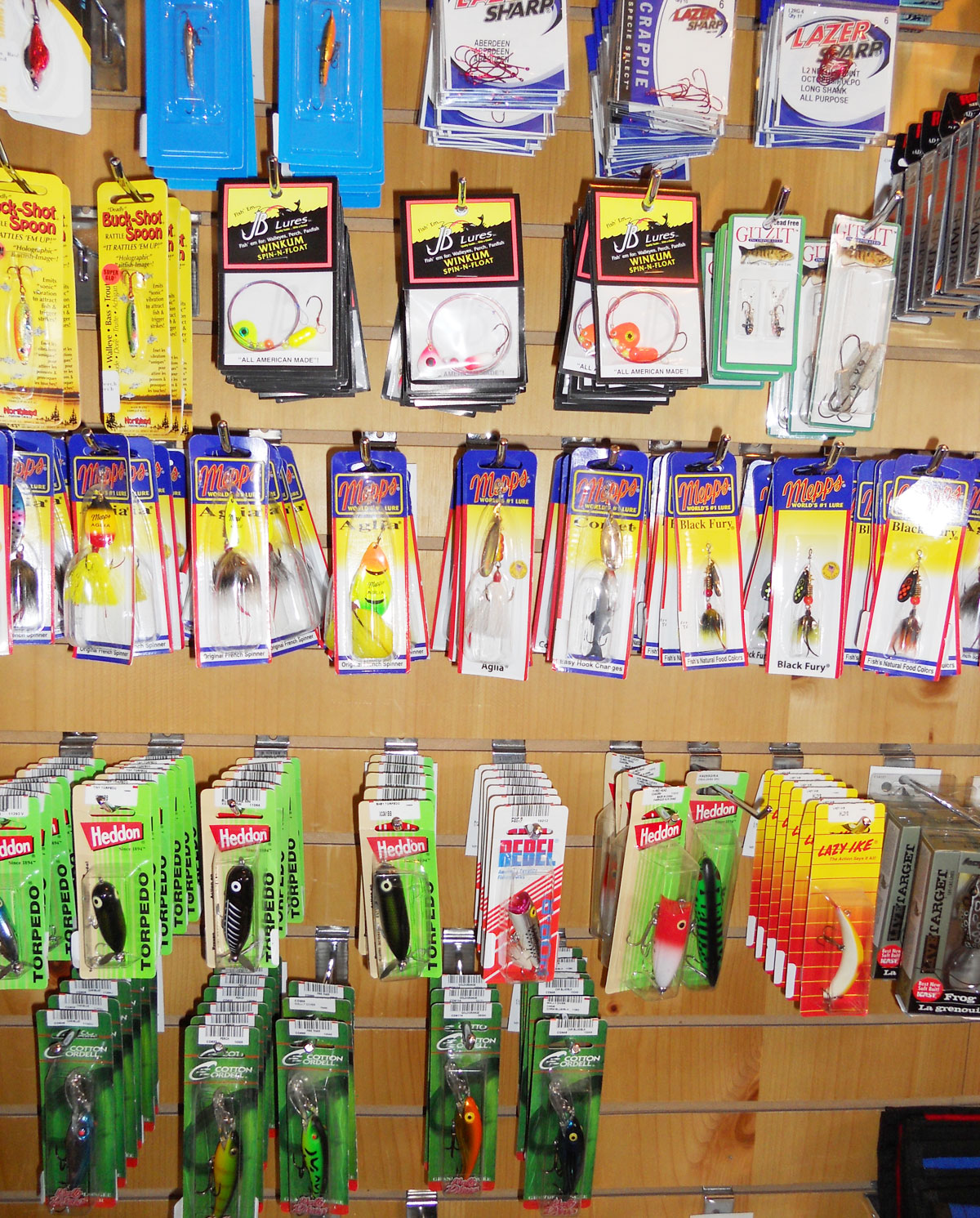


Mepps Spinners in just about any size seem to attract fish on days when nothing else will work. That being said, they were always my Dad's favorite lure and he used them almost exclusively. Mepps with bucktails for trailers bring big pike in too!

There's a handful of terminal tackle and tools that you should have in your tackle box or pack. That brings to mind what you are going to carry all of this stuff in. Flat Plano boxes work well and fit in stowaway packs under the canoe seat or hang from the thwarts. Some soft tackle carriers fit in portage packs easily. Taking your fully outfitted (and often large) favorite tackle box isn't recommended.

Terminal tackle needs include: non-lead sinkers, slip bobbers and stops, plain shaft or octopus hooks (sizes 6 and 4), leaders (stainless or black metal), snaps and swivels.

Extra line is good to have as we've already noted. A good pair of needle nose pliers, a stringer, a net (collapsible) and a sharpened filet knife round out your list of necessary Tools.

As a postscript I always take along a favorite lure for walleye fishing off the campsite. This is a killer lure, that is really just a hook, spinner and float. Made by JB LURES it is the little known, but highly effective WINKUM Spin-N-Float. Just tie on a swivel and snap to the end of your line, put a heavier split shot for weight before the swivel, slip the loop on this rig onto your snap and rig a minnow, leech, worm, gulp artificial bait or twisty tail on the #4 octopus hook and you are ready for action. Upon casting it out, the weight sinks, the float raises your bait up off the ground and the spinner flashes around like a one-eyed wounded bait fish. You'll have time to feel your line being taken and see the end of your rod being yanked down before you set the hook!

NOTE ON COLORS and PRESENTATION Popular color combinations are chartreuse, pink, clown, perch and firetiger along with blue and silver shad. Black is a surprisingly effective color for jigs and plastics as well. As always, the most natural presentation you can rig will always bring the best results. Simple knots on a plain hook with a worm and a split shot a foot or two up will produce fish without being fancy when you fish off of the bottom. Tie your artificial baits on to "swim" naturally and retrieve them as such and you will do better. Look for sunken trees, rocks and structure when fishing for bass and weed beds for pike. Walleyes like points and structure transitions on the lake bottoms most.

Lure Lock'r. Keep those hooks from snagging and keep your favorite lure ready to go on your rod without tangling.  Don't leave home without them!  Lure Lock'rs Here.

RODS and REELS. We sell a great and affordable (less than $35 for rod and reel) combination from Okuma called the Finchaser Combo here at Piragis in Ely. If you want to leave your expensive rod at home because you don't want to chance a snap in the wilderness with portages, trees and snags, you can't do much better than these rods and they'll be a step (way up) for the kids or company to use when you get home.

Why Non-Lead? Common Loons gobble up lead jigs, sinkers and split shot and as a result die from lead poisoning. We are committed to keeping our State Birds happy and healthy.


Fishing with Kids: Read this Blog Post specifically written about fishing with kids 

Tim Stouffer
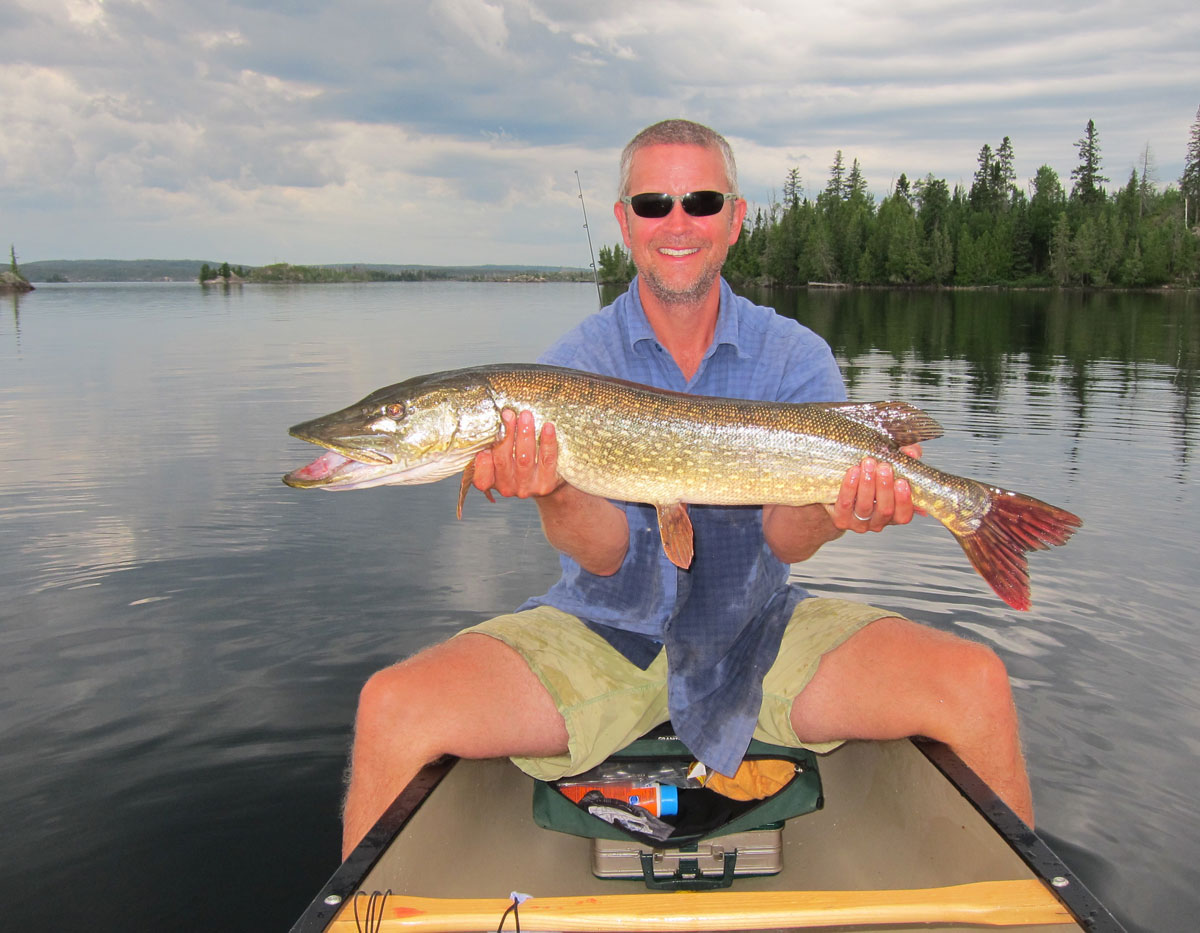


One of our Canoe Trip Clients submitted this photo of a Boundary Waters Northern Pike

BLOG 46. Wilderness Signaling Devices

WILDERNESS SIGNALING DEVICES

by Cliff Jacobson

In June, 1967, my friend, John Orr and I made our annual pilgrimage to the Boundary Waters Canoe Area of Minnesota.  Along a portage, we met a group of teenagers who were carrying a 15 year old girl on an improvised stretcher.
           
She said she had a “stomach ache” and had taken Tums and Pepto Bismol, but they didn’t  help.  When John--a football coach--gently touched her abdomen, she shrieked in pain.  He diagnosed appendicitis and suggested we evacuate her immediately.
           
Then, a miracle!  As we were loading her into a canoe, a forest service fire plane appeared on the horizon (really!).  I whipped out my Silva compass and luckily, the mirror flashed the pilot’s eye.  He saw our frantic waves and settled on to the lake. Then, he flew the girl to Grand Marais, where her appendix was removed without complication.

This was the only time I have signaled for help in a medical emergency.  But I have used signals for other reasons.  Here’s what I carry in my kit:
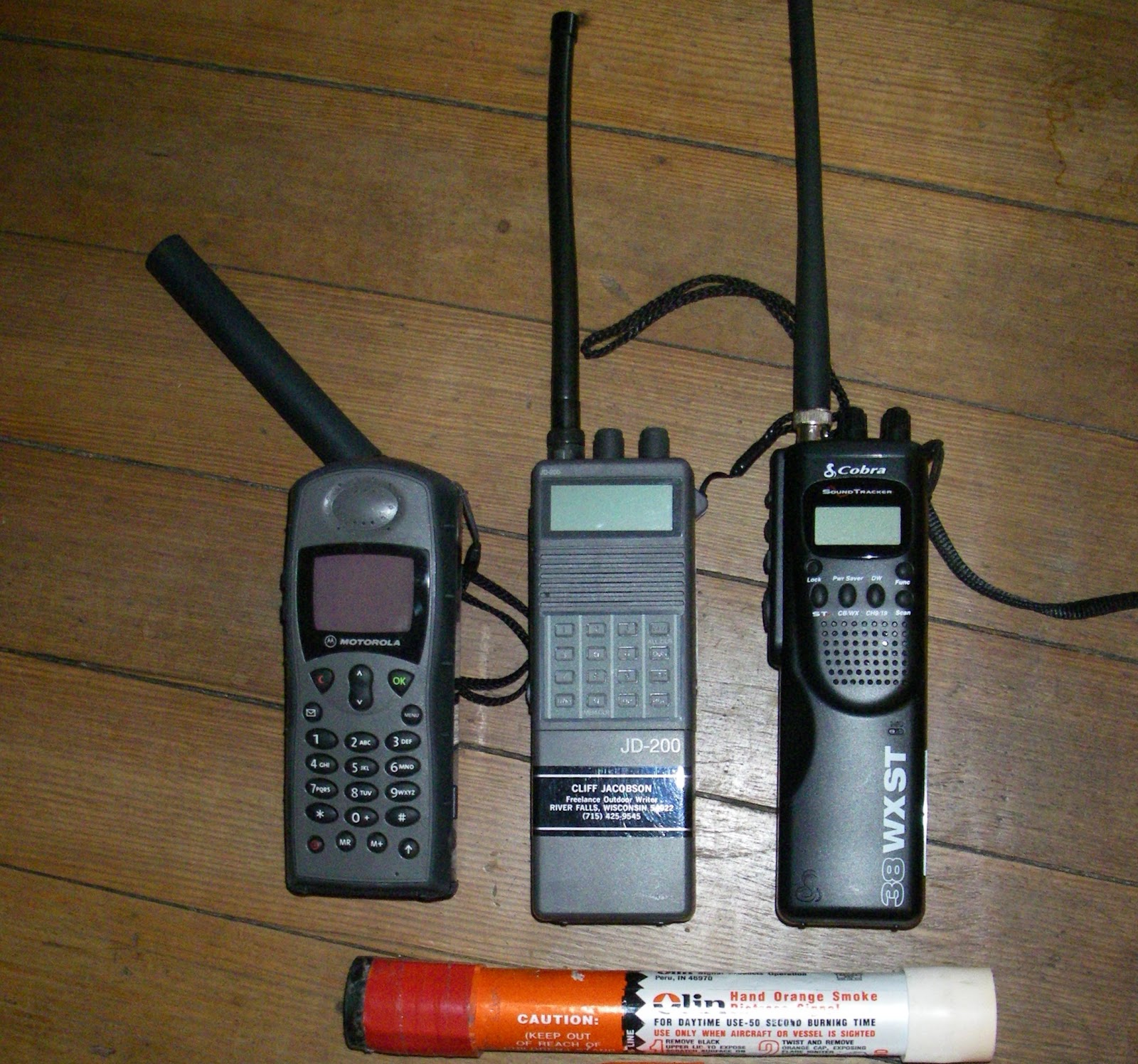
L to R: Iridium Satellite phone, VHF Aircraft Radio, CB radio, Orange Smoke
ORANGE SMOKE DISTRESS SIGNALS
These burn for 50 seconds or more and produce bellows of thick orange smoke which, on a clear day, can be seen for miles.  I have used orange smoke’s twice, and each time, they caught the pilot’s eye.    Every marina has them.

EMERGENCY SIGNALING MIRROR (HELIOGRAPH)
It is very difficult to precisely flash an object with a standard mirror like the one on an Orienteering compass.  I bring a military (ESM/1) signal mirror, which has an aiming cross in the center.

WHISTLE
You may not hear a whistle above the roar of rapids--that’s why you should know the official hand (safety) signals.  But a whistle works if you wander off a bush-whacked portage trail and become confused. Pea-less type whistles like the Fox 40, which work when flooded, are best.

COLOR COUNTS!
Choose brightly-colored canoes, packs, tents and clothing that can be seen from an airplane!


VHF TRANSCEIVER (JD200 Tranceiver/Sporty’s Pilot Shop)
An aircraft you can see is probably within ten miles of you—close enough to be reached on a hand-held VHF aircraft transceiver. The typical VHF radio with a 15 mile range allows about five minutes of talk time at typical float plane speeds.  As a courtesy, most bush pilots will circle and keep you in range until the conversation is done.  But high flying jets won’t change course, so you better talk fast.  One of my greatest thrills was getting weather conditions from a passing Calm Air passenger jet.  We talked for about 20 seconds. In a life-threatening situation you may broadcast on the restricted emergency frequency (121.5 megahertz), which all pilots monitor.  But for other concerns you must stick with the frequencies that are assigned to the charter air companies.  Be aware, that transmitting without an FCC license isn’t strictly legal!  In the bush, however—and given the short range of hand-held transceivers--everyone looks the other way.  Indeed, most charter air services are pleased that you have a radio.
 Note:  You must have an aircraft model VHF radio to talk to pilots.  A  marine band VHF radio won’t work.  Aircraft models are much more expensive than marine radios and are generally available only from pilot shops.

CB RADIO
If you charter a power boat on Hudson Bay or one of the big Canadian lakes, you’ll want a CB radio so you can communicate with the captain.   Naturally, you must know the channel of operation before you call.
GPS
When we reached the complex delta at the mouth of the Tha-anne River on Hudson Bay, I called my charter boat captain on my CB radio. 

He said, “Better hurry—tide goes out in 30 minutes!”

I punched his position into my GPS.  Twenty minutes later, the white fishing boat came into view.  When time is short, or bad weather threatens, a confident course can make a difference!
SPOT Satellite Messenger
SPOT and DeLORME InREACH
These satellite messengers are lightweight, compact, waterproof and—if the weather cooperates—reliable.  A button push will initiate search-and-rescue operations. The basic SPOT allows you to send three prewritten messages and your GPS location/tracking to your contacts via text and/or e-mail. More advanced SPOT units, and the DeLorme inReach GPS locator allow you to send text/eMail messages through your smart phone. A subscription plan is required.

I prefer the basic SPOT which uses AA batteries. Satellite texting through your smart phone makes sense only if you have a way to keep your cell phone charged on a long trip—and if you can afford the pricey subscription plan.
 
DeLorme inReach with PN-60 GPS


SATELLITE PHONE
If you’re going where help is an airplane ride away, a satellite phone is the way to go. Satellite phones operate just like regular phones, except that calls must be dialed in international mode. I’ve used my sat phone many times on canoe trips and it always been reliable.  Rental phones, however, can be troublesome because the batteries have been recharged so many times.  Every failure-to-function I’ve observed has been the result of batteries that won’t hold a charge.  Rental phones should come with an extra battery AND a solar charging unit!

Cliff Jacobson
www.cliff-jacobson.com


Wednesday, May 15, 2013

Ice Out Conditions From Forest Service as of Tuesday Night, May 14


 Tuesday PM, May 14, 2013 

A strong crosswind grounded the fire patrol this afternoon. New information from observers: 
• Disappointment is open. 
• Parent Lake (near Snowbank) is iced. Snowbank is still iced in. 
• Rice and August Lake are open. 
• Vermilion Lake was iced in yesterday. 
• Big Lake was reported open yesterday, but southerly winds pushed the ice pack to the northern half today. 
• The North Arm of Burntside is still frozen. The East Arm is full of dark ice. 

This information is from Monday’s flight: 
• Moose Lake: southwestern third is open; northeastern two thirds frozen but dark ice. 
• S. Kawishiwi R. and Gabbro Lake are mostly open. 
• Turtle is open. 
• There is ice in the middle of Bald Eagle. 
• Clearwater and Pietro are frozen (thin ice) but Gull is open. 
• Quadga and Bog are open. 
• Isabella and Perent still have a lot of ice in the middle. 
• Polly and Phoebe are open. 
• Alton and Sawbill are still frozen. 
• Generally the smaller lakes in the south east are open or mostly open. Larger lakes are still frozen. 
• Alice is frozen. 
• Insula south of The Rock is open, the northern portion is frozen. 
• Lake 3 is mostly open. 
• Knife Lake including the South Arm is mostly ice. 
• Saganaga is still frozen. 

FS Pilot report—this information is from a flight late Sunday afternoon. 
• Jackfish- 40% open 
• Open: Pipestone, Stuart, Agnes, Nina Moose, Ramshead, Upper and Lower Pauness 
• Frozen: Oyster 
• Bald Eagle- 60% open 
• Gabbro- 75% open 
• Open: Gull, Turtle, Lakes 1 and 2 
• Clearwater- frozen, but open around the edges. 

Today’s safety message: Bears are awake and hungry. Keep a clean camp. 
Winds are drying fine fuels quickly. Be careful with fire 

Ice on Burntside Lake Wednesday Morning, May 15, 2013 by Steve Piragis

Ice is hanging in on bigger lakes around the Boundary Waters.  Here are a couple images from this morning, Wednesday, at the landing on Van Vac Rd on Burntside Lake.  This is a deep lake and this is the widest part.  Bays are open and narrows but the big lakes indicated here are still covered with black ice.  The forecast calls for strong nw winds today after an unusually warm day with sw winds yesterday.  If you are planning a canoe trip for this week check in with us on your route for advise.  I'd expect ice out on all lakes by the weekend but this year's ice seems pretty tenacious.

Steve Piragis


Monday, May 13, 2013

Ice Out Conditions May 13, 2013

Boundary Waters Ice Out Conditions:

The latest from the Forest Service:

Today’s Safety Message:
• Grasses are dry and cured. We’ve had a few small fires. Keep fires small and stay nearby.
• Winds will be from the south at 5 to 15 mph but with gusts up to 30 mph. Wear PFDs.
FS Pilot report—this information is from a flight late Sunday afternoon. There is a flight up now so more
information will be sent later:

Pipestone- open
Jackfish- 40% open
Stuart- open
Agnes- open
Oyster- frozen
Nina Moose- open
Ramshead- open
Upper & Lower Pauness- open
Bald Eagle- 60% open
Gabbro- 75% open
Gull- open
Pietro- open
Clearwater- frozen, but open around edges
Turtle- 25% open
Lakes 1,2,3 open
Moose Lake: southwestern third is open; northeastern portion frozen but dark ice.

Followers