Monday, December 10, 2012

BLOG 32. USFS/Leave No Trace Video

BLOG 32. USFS/Leave No Trace Video
by
Cliff Jacobson
The Forest Service video, “Leave No Trace” is required viewing for everyone who goes to the Boundary Waters.  The film contains a lot of good information, but it also has some advice that is silly or dead wrong. Heading the “silly” list is the admonition to leave your axe at home.  The message is that a Swiss Army knife and jack-knife pruning saw are all you need to make a cheery blaze on a rainy day.  If you’ve spent much time in the Boundary Waters you know that on most campsites, all the good wood has been picked over.  Making fire often means splitting a chunk of log to get at the dry heartwood in the center.  For this, you need a full frame saw and a splititng tool (an axe of some sort).

Here are three more “silly points” from the video:

1.  “Don’t trench your tent (I agree); it causes needless soil erosion; besides, modern tents with built-in floors will keep out flowing ground water.” That alone is worth a chuckle.  Wouldn’t it be better to just ask everyone to use a plastic groundcloth inside their tent? (rationale: see blog #2, Old ideas die hard). 

2. Avoid brightly colored gear—it takes the “wild” out of wilderness.  Yeah, and it also complicates emergency rescue and makes your photos not worth viewing.
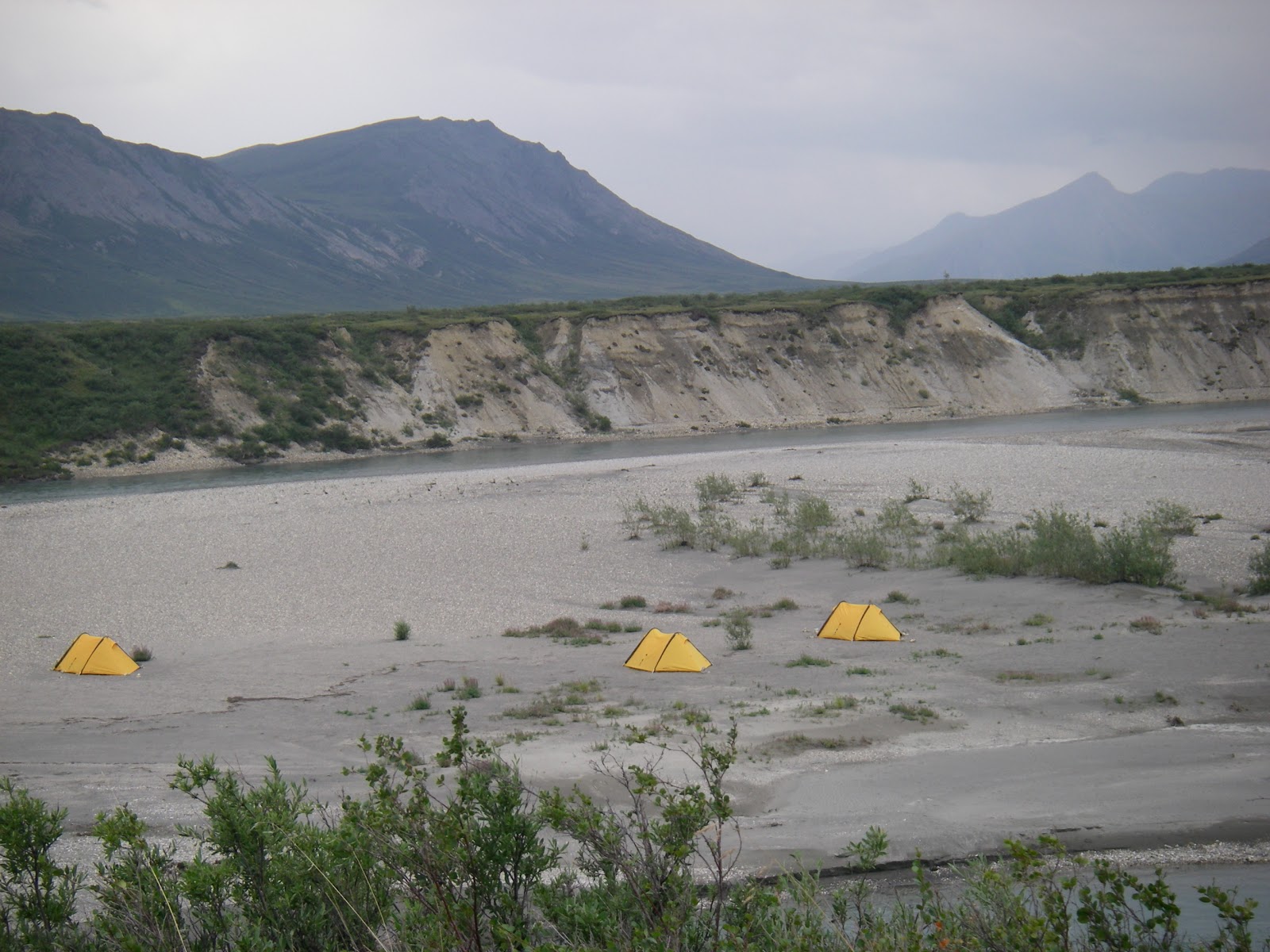
Choose brightly colored gear for safety.  Noatak River, Alaska

3. Tree your food packs every night. Ok, enough; we’ve run this one to death in previous blogs and writings.

Completely wrong, is the recommendation to throw rocks at a bear (“and try to hit him!”) that comes into your camp.  We did this once on a canoe trip down the Fond du Lac River in Saskatchewan and that bear nearly had us for dinner.  She chased everyone out of camp and forced one man into the lake(!). Then, after we’d put to sea and had rounded a point, we saw her perched on a rock, chest-deep in water, clacking her teeth and woofing at us.  I believe this bear would have killed us had we stayed around.  Yes, there IS a time to throw rocks at a bear, and that is when the bear is attacking someone—i.e., human life is in danger.  Otherwise, don’t do it!  The personality of bears, like humans, runs the gauntlet from “gentle and nice” to “extremely mean!” Antagonize  a mean-spirited bear and he may come after you!
Noatak River, Alaska.  Note the ugly steel "bear barrels" in the background
If you canoe the Noatak River, which flows through ANWR (Arctic National Wildlife Refuge), you’ll be treated to the Alaskan version of the “Leave No Trace” video. The film begins by telling you to camp on “durable ground”—that is, ground that won’t be flooded by heavy rain.  But the camp that’s pictured in the video is pitched on a gravel bar which is definitely not a “durable” surface.  Indeed, durable sites on the Noatak are a long ways from the river. Unless you are willing to haul your gear 100 plus yards up a high hill, you’ll camp on non-durable gravel close to the river.  

Here’s the recommended procedure for campfires, as given in the video:
1.    Make your campfire on gravel, close to the river.
2.    First, place a large square of plastic on top of the gravel then pile a thick layer of gravel on top of the plastic.  Build your fire on top of the gravel.
3.    Allow your campfire to burn out completely then lift the plastic and toss the ashes into the river so as to leave no trace.  Pack the plastic and keep it handy for future fires.

Okay, picture yourself doing this for every campfire you build. And who’s the lucky one who gets to pack the sooty plastic sheet that may be wet and sloppy from rain or a water-doused fire?  I doubt that any feds who canoe the Noatak do this!  Wouldn’t it be better to simply say: “Burn your fire down as much as possible, then before you leave, toss the burned remains into the river.”  Given the small amount of traffic on the Noatak, and the fact that spring rains will completely flood the gravel bars, there is little basis for this recommendation.
Camp on "durable surfaces".  This gravel bar isn't one of them.  Notice that it's nearly a quarter of a mile hike to a government-approved "durable surface".  No, the fire is not built atop a plastic sheet!

Then there’s the heavy steel food barrels that paddlers are required to carry. These “bear barrels” are not waterproof and they don’t have carrying handles or grab loops. They are awkward, slippery, cold to the touch and they roll around. There is no way to portage them, save for throwing them up on your shoulder, pirate style. Two barrels at most, will fit in a 17-foot canoe and each barrel will nearly fill the space between the yoke and closest thwart. I admire those who will tote these heavy, food-filled metal barrels 100+ yards up a hill to a “durable surface” campsite.
Another example of camping on a "non-durable" surface

Federal authorities mean well and they try to do the right thing.  Indeed, most wilderness regs make sense and should be taken seriously.  But silly “feel good” rules are quite another matter. 

Cliff Jacobson
www.cliff-jacobson.com

The lakes are calling and I must go!


I always dreamed of living somewhere close to water.  Close to lakes, to be precise because I grew up near the Rock River in Oregon, Illinois.  Back home I would ride my bike over to the Honey Creek on gravel roads that meandered into town the long way; the back way.  I could sit there, when I got the chance, for hours watching a bobber or flipping a Mepps spinner over and over again.  Occasionally Dad and I would park our car near the dam in town, walk down the bank and stand on the rocks to cast for walleye in the rushing water.

We swam in the town pool with enough chlorine to turn your hair green on long summer days.  Those days only made me long for a country of lakes even more.  Just to be able to sit by one.  To cast a line when I wanted, to jump in when it got too hot.  To listen to its songs after the darkness fell.

My dream wasn't huge… I didn't have to own property on a lake or a second home/cabin with my own beach.  I just wanted to be nearer to water than I was.  Preferably water that didn't have its own perfume of "river".  

For many people, Ely, Minnesota is the personification of that dream.  When they think of such a place as I did during my childhood, they ultimately see a green sign with only three letters: "ELY".

As I grew older I thought about how great it would be to leave work at the end of the day and go fishing somewhere.  To grab a canoe and just go.  In my mind I saw only water and endless possibilities.  That was my Ely.  More lakes than I knew what to do with.

Somehow I made it here and began life all over again as a husband and then a new father and life itself got busier and busier.  The dream stayed alive, but now that I was living it, it changed to encompass Little League and ballet and church and friends and family and a career and traveling and art and new books and more art and antiques and hobbies and…

The lakes are calling and I must go.  Yes, it is a take off from a John Muir quote, but it is a fact.  A fact of life.  They call.  Loudly.  So now, I answer the call.

One of the most exciting things is to go to work with the knowledge that when your work day is over a canoe trip awaits.  Portage packs full, family ready, dog ready, canoes on the van, Zups Polish in the cooler, fishing rods and hammocks -- check, check.  I can hardly wait.

When I am loaded up and the afternoon sun is tattooing its mark on the back of my neck as I stretch my paddle to the campsite up ahead, then I relax and think, how lucky I am to be living my dream.

Do the Lakes call you?  We're going to make this design into a t-shirt for next year.  Look for it in a catalog coming to you in March!  Answer the call!


Friday, November 30, 2012

BLOG 31. Camping Quiz

BLOG 31. How Much Do You Know About Camping?
by
Cliff Jacobson
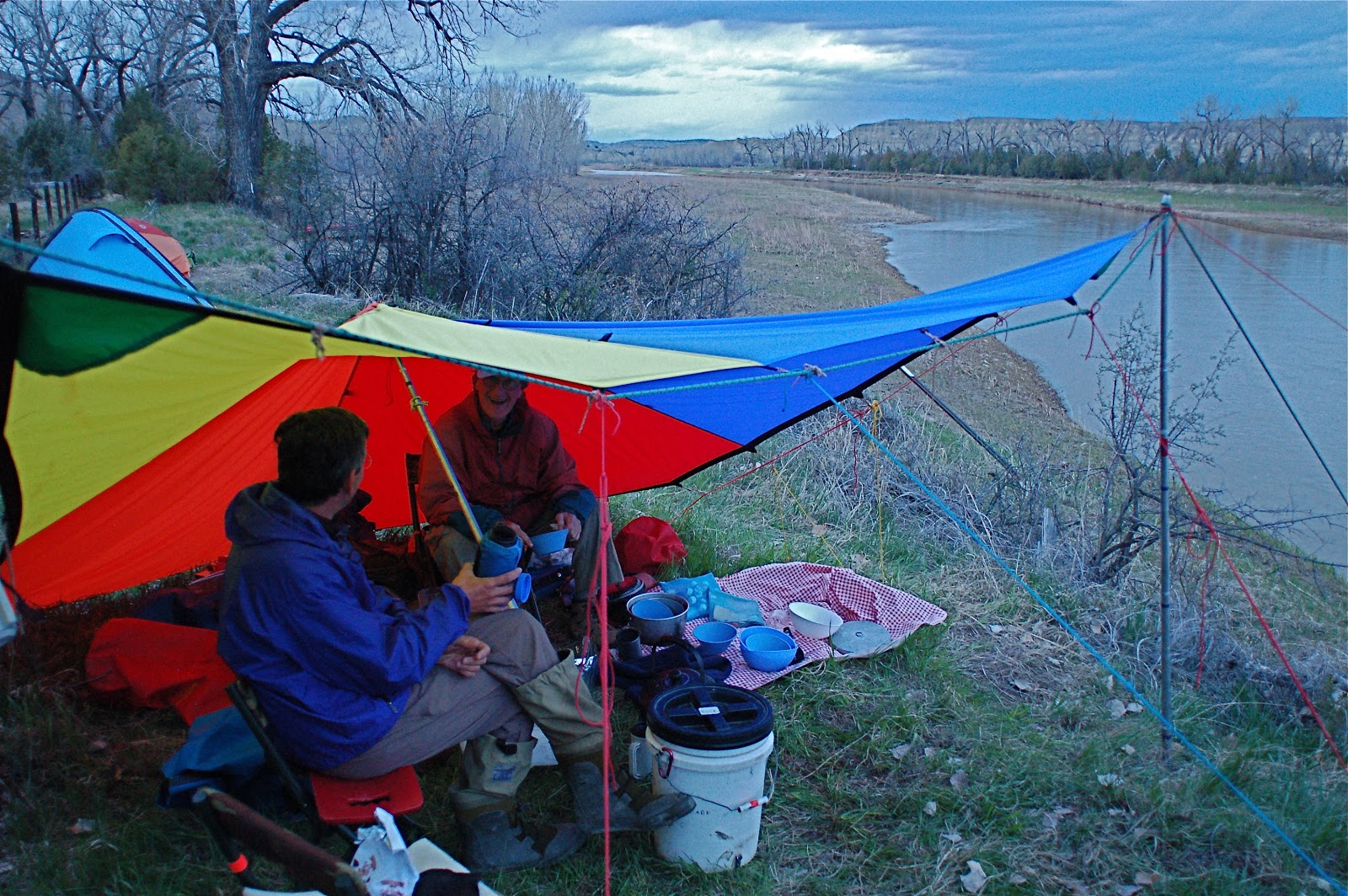
Little Missouri River, North Dakota. Jim Mandle (L); Cliff (R)
Can you rig a tent so it will withstand an all night storm? Do you know what to do if a bear visits your camp?  Are there ways to keep mosquitoes and black flies from honing in on you?  Can you make accurate weather predictions without the aid of tools or TV?  Take this tough little quiz and see how much you really know about the wild outdoors. 
           
Hint: Some questions have more than one right answer, and some answers are “open to interpretation”.
QUESTIONS

1.  You are camping at a popular site.  Your freeze-dried and canned foods have no odors to attract bears.  Still, you are concerned that a hungry bruin might find your camp.  Best plan is to:

            a)  attach a rope to your food pack and hoist the pack into a tree.  The pack should be at least 15 feet off the ground.  Rope marks on a large limb suggest that other campers have “treed their packs” here.
            b)  Set your food pack inside your tent or car.
            c)  Place your food pack under an overturned canoe or fishing boat.  Set metal pots on top of the canoe or boat to function as an “alarm system” if a  bear comes while you’re sleeping.
            d) Take your food pack out of the campsite and hide it in the bushes, well away from animal trails.

            1. ANSWER:  d) is the best plan.   Habituated bears know that food comes in cans, packs and boxes. They quickly learn that food grows on certain trees!  Why? Because there are usually just a few trees in a typical campsite with limbs that are high enough to discourage a bear.  Campers all put their food in these trees.  Bears are excellent climbers!  Indeed, they are so adept at getting treed food packs, that campers in western parks call the treed packs “bear piƱata’s”.
Black bears are excellent climbers.  This bear is high in a tree, in an eagle's nest.  It's after the eaglets or tasty eggs.
2.  The best way to keep water out of your tent when it rains is to:

            a) Dig a trench around the perimeter of your tent and slope the trench so rain water drains away.
            b) Place a plastic ground cloth under the floor of your tent.           
            c) Place a plastic ground cloth inside your tent.
            d) Pitch your tent on a slight incline so that flowing ground water will drain away from your tent.

            2.  ANSWER: “C” is correct.  Groundwater commonly enters a tent through ground level seams or worn fabric.   An interior ground cloth keeps accumulated water away from your sleeping gear.  NOTE: It is unethical and illegal to “ditch” a tent!    
Note interior plastic groundcloth.  Tent is a NEMO 2P
3.  Which is the best way to sharpen a knife?  Raise the blade about 15 degrees to the stone and:

            a) cut firmly into the stone with a long sweeping motion.
            b) draw the edge away from the stone with a long sweeping motion;
            c) hold the stone steady and rotate the blade in small circles.
            d) hold the knife steady and rotate the stone in small circles.

            3.  ANSWER: (a) will best provide a uniform sharp edge.  Use “C” if you have a very small whetstone: however, this procedure will not produce a uniform sharp edge. “d” is ineffective and possibly dangerous.
Cut INTO the stone, like you're taking a slice out of it
4.  True or False:  Modern polyester-filled sleeping bags should be drycleaned or washed by hand: they should never be washed in a washing machine.

            4.  ANSWER: False!  Never dryclean synthetic sleeping bags or fleece garments.  The drycleaning solution may dissolve the fibers!  Machine washing with gentle detergents is the best plan. 
           
5.  Which of these would make the best tinder for starting a campfire on a rainy day?
            a) newspaper, b) finely split cedar wood, c) dry splittings taken from the stump of a dead pine tree, d) dead leaves
           
            5.  ANSWER: conifers concentrate highly flammable resin (pitch) in their roots.  Splittings taken from this “fat wood” (c) burn brightly for many minutes, even in rain.  Finely split cedar wood (b) also makes great tinder.  Dead leaves work only when bone dry and when not in the advanced stages of decomposition.  Newspaper is “hydrophilic”--it absorbs moisture from the air--and the poorest tinder of all. Count your answer correct if you said “b” or “c”.
           
6.  Your tent is pitched on an incline.  Best plan is to pitch the tent with the:
            a) head end facing uphill, b) head end facing downhill.
            c) head end perpendicular to the incline (one side of the tent is higher than the other);
            d) it doesn’t matter.           

            6. ANSWER:  Pitch your tent across the incline (c) and level your bed by placing spare clothes under the down hill side of your sleeping pad. This will produce a level sleeping platform.   

7.  You’ll be the master of any camping and boating situation if you know these three important knots:
            a) bowline, square knot, tautline hitch;
            b) bowline, crown knot, fisherman’s knot; 
            c) diamond hitch, square knot, two half hitches;
            d) two half hitches, sheetbend, power-cinch (trucker’s knot).

            7.  ANSWER: (D) will “do it all
           
8.  Whenever you pitch a tent or rain tarp, or rig a clothes line in camp, you should always end your knots with:
            a) a double half-hitch around the bite;
            b) a slippery or quick-release loop; c) a bow;
            d) a monkey fist or crown.

            8.  ANSWER: End your knots with a “slippery” loop (b) and  they’ll come apart instantly when you pull the bitter end of the rope. 

9.  You are boating on a large lake and are “mightily confused”.  Fortunately, you have a simple map and a battery operated GPS (global positioning system). The map in your GPS is very basic, with little detail. Your paper map is better; it shows the structure of the shoreline and the major islands, but there are no contour lines or latitude/longitude marks.  The direction of true north is given, but the magnetic declination for the area, is not.  You planned to stay near shore so you didn’t  program the GPS with your starting position.  
            To find your way “home”:
            a) turn on the GPS and obtain a coordinate fix.  Follow the bearing provided by your GPS to your starting point..
            b) Your paper map does not have a coordinate system so the numbers provided by your GPS are useless.  Use your compass and try to backtrack.
            c) You must know the area magnetic declination to program your GPS.
            d) Your map does not have contour lines so both your GPS and compass are useless!
           
            9.  ANSWER: Your GPS is useless (b)!  You must program your starting position to  get a  “bread crumb trail” home. 
You must program your starting point if you plan to return to it.

10.  Your map shows a small fishing pond deep in the woods, about two miles due south (true bearing equals 180 degrees) of your location.   The magnetic compass declination (as given on the map) is 10 degrees west.  What magnetic compass heading must you follow to reach the lake?

            10.  ANSWER: a) 190 degrees
           
11.  A storm is brewing as you are setting up your tent.  You should pitch your tent:
            a) with the entry-way facing the wind;
            b) back-end facing the wind;
            c) on a quartering angle to the wind;
            d) the direction makes no difference.
           
            11.  ANSWER: Back-end (b) or quartering (c) to the wind is usually  best.  This keeps door zippers and seams in the lee of wind-driven rain.   This is more important with A-frame style tents than with domes.  Some A-frame tents have one end higher than the other.  It’s best to pitch them with the low end facing the wind.

12.  You cook your meals on a gasoline trail stove.  Which of these is a bad practice?
            a) Dump out the gas after each trip and burn the stove dry.  Fuel up with fresh gas just before each trip;
            b) Never refuel a hot stove;
            c) Don’t set over-size pots on the burner of a small trail stove.  
            d) Use unleaded automotive gasoline in “multifuel” stoves.
           
            12.  ANSWER:   (d) Automotive fuels are much dirtier--and may be more volatile--than refined naphtha (Coleman and Blazo fuels).  Regular use of auto gas will clog valves and put your stove out of commission.  Best to burn naphtha (white gas) in your multifuel stove. Gasoline left in stoves for long periods turns to varnish.  If you must keep fuel in approved cans or bottles over the winter, keep the containers nearly full to reduce oxidation. 
           
13.  Which of these clothing combinations would be bad to wear in cold, rainy weather where hypothermia is a concern?  Clothing layers are listed from the skin out.
            a) wool long underwear, wool shirt, rain coat;
            b) polypropylene long underwear, polyester fleece sweater, rain coat;
            c) polyester long underwear, wool shirt, rain coat;
            d) cotton long underwear, polyester fleece sweater, rain coat;
            e) wool long underwear, cotton shirt, rain coat.

            13.  ANSWER:  “d” is unacceptable, “e” is a poor choice.  Cotton wicks moisture and heat from the skin and should never be worn in cold, rainy weather.  If you must wear cotton, wear it over wool or synthetics.  Polypropylene, polyesters and wool can be worn with confidence in cold rains. 
                       
14.  You have spotted a black bear around your campsite.  Fortunately, you have a can of cayenne pepper spray which will deter bears about 75 percent of the time.  Which of the following should you never do?
            a) spray your food pack and tent entrance with pepper to keep the bear away;
            b) spray the bear when it comes into camp;
            c) spray the bear only if it attacks you.
           
            14.  ANSWER:  (a) will get you into real trouble!  Bears don’t like to be sprayed in the face with pepper, but they do like the taste of it.  When rafters in Alaska sprayed their rubber rafts with pepper to keep bears away, the bears ate the rafts. Don’t test-fire a can of pepper spray around camp.  The residual pepper (on the can) might bring a bear to you!  Spraying after the bear attacks you may be too late!
Spray aggressive bears with pepper.  DON'T spray "things"!
15.  You’re pulling away from the dock for a day’s fishing on the big lake.  The sky is deep blue, but overhead, there are wispy cirrus clouds which resemble mare’s tails. 

            a) You’d better cancel your trip--a bad storm is brewing;
            b) A gentle rain will begin in an hour or so.  The rain won’t last long;
            c) Don’t worry; it won’t rain today, but it will tomorrow.
            d) These are fair weather clouds--you can count on at least two days of good weather.
           
            15.  ANSWER:  (c) is correct.  Cirrus clouds are composed of ice crystals, thrown skyward by an approaching warm front.  Nimbostratus clouds (dark gray rain clouds that cover the entire sky) are 24-48 hours behind.  It will rain tomorrow, or the next day--probably a slow, long rain. 
           
SCORING

14-15:   Expert camper:  Your friends shouldn’t go camping without you.
12-13:   Guide in training:  You are the envy of your friends.
10-11:   Faithful follower:  Keep learning--you’ll be a pro in a few years.
Below 11: Wishful thinker: You may want to read some good camping books before your next outing!

XXX


Free Shipping at the Boundary Waters Catalog


Use Code FREEX12 for Free Standard Shipping through Christmas Eve. Oversized item charges still apply. Lower 48 states only. Can be used multiple times with no purchase limit or minimum.

http://www.boundarywaterscatalog.com/index.htm?PROMO=FREEX12


Thursday, November 29, 2012

New Guided Boundary Waters Trip for 2013


Stargazing in the BWCA Canoe Trip

Trip Dates: September 7 – 13

Call Drew Brockett or Adam Macht 1-800-223-6565

Trip Cost: $1195 + tax

6 days paddling, 5 nights camping
First and last night hotel room in Ely

Please Note: Final payment for our guided group trips is due 30 days before the trip begins.

No where else can you see the stars and Northern Lights so clear at night than the wide open wild spaces of the Boundary Waters Canoe Area Wilderness. Our backyard is void of man-made lights and it is far from the plumes of industry that cloud and obscure the natural beauty of night's canvas. There is something ethereal, surreal about the constellations when you view them in solitude. Join us for a magical time as we track the power of the great bear and map the path of Orion's belt accompanied by the haunting backdrops of the calls of the common loon and howls of the elusive timber wolf. Imagine lying on your back on a comfortable therm-a-rest gazing at the limitless vaulted inky black ceilings brimming with stars.

Discover Cassiopeia, the Twins, Andomeda, Orion, Taurus and more. Learn how to mark Alpha Stars such as Betelgeuse and Polaris to find their different mythological shapes in the sky.

Would you like to…
- View the night sky uninhibited by light pollution?
- Learn about constellations, both where they are located in the sky and the stories behind them?
- View the Milky Way in all of its splendor?
- Have a chance to see the Northern Lights?
- Explore and fish the BWCA?
- Learn canoe camping techniques from our expert guide?
- Relax and unwind in a beautiful wilderness setting?
If you answered yes to any of these questions, our Stargazing in the BWCA trip is right for you.

Since the beginning of time, humans have been drawn to the night sky. The vastness of the universe holds instinctive intrigue. Join our 6 day 5 night Boundary Waters canoe trip to gaze upon the heavens like never before.

Our trip will take you far away from the sights and sounds of the city, into the heart of the wilderness, where our stargazing will be undisturbed by light pollution. We will leave Ely one day after a New Moon for optimum darkness. The constellations and Milky Way will pop out of the night sky like many have never seen.

Enjoy the night sky like you never have before in the quiet solitude of the BWCA. Bring the kids. This trip is sure to create memories that will last a lifetime and inspire wonder.


Followers