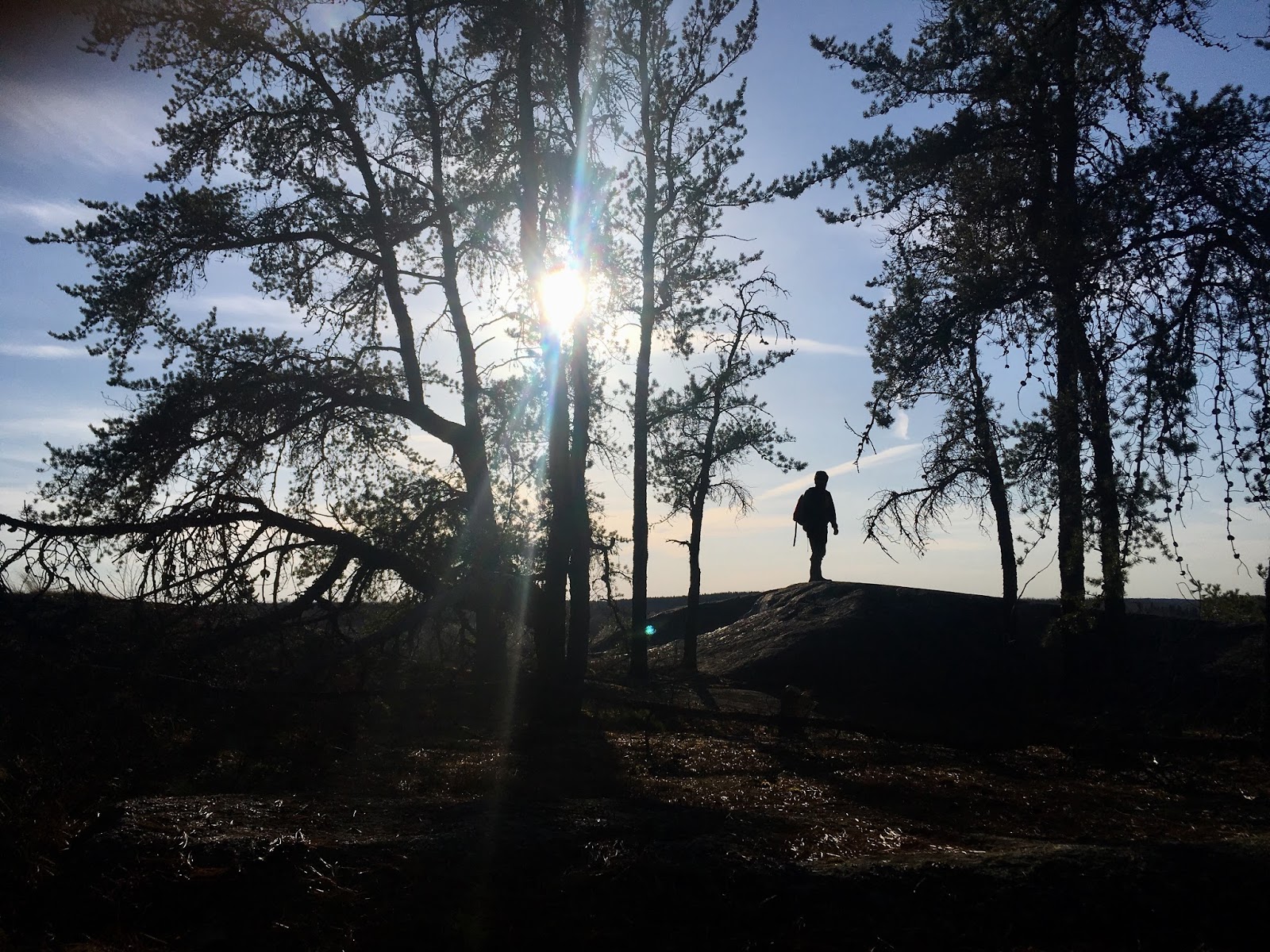
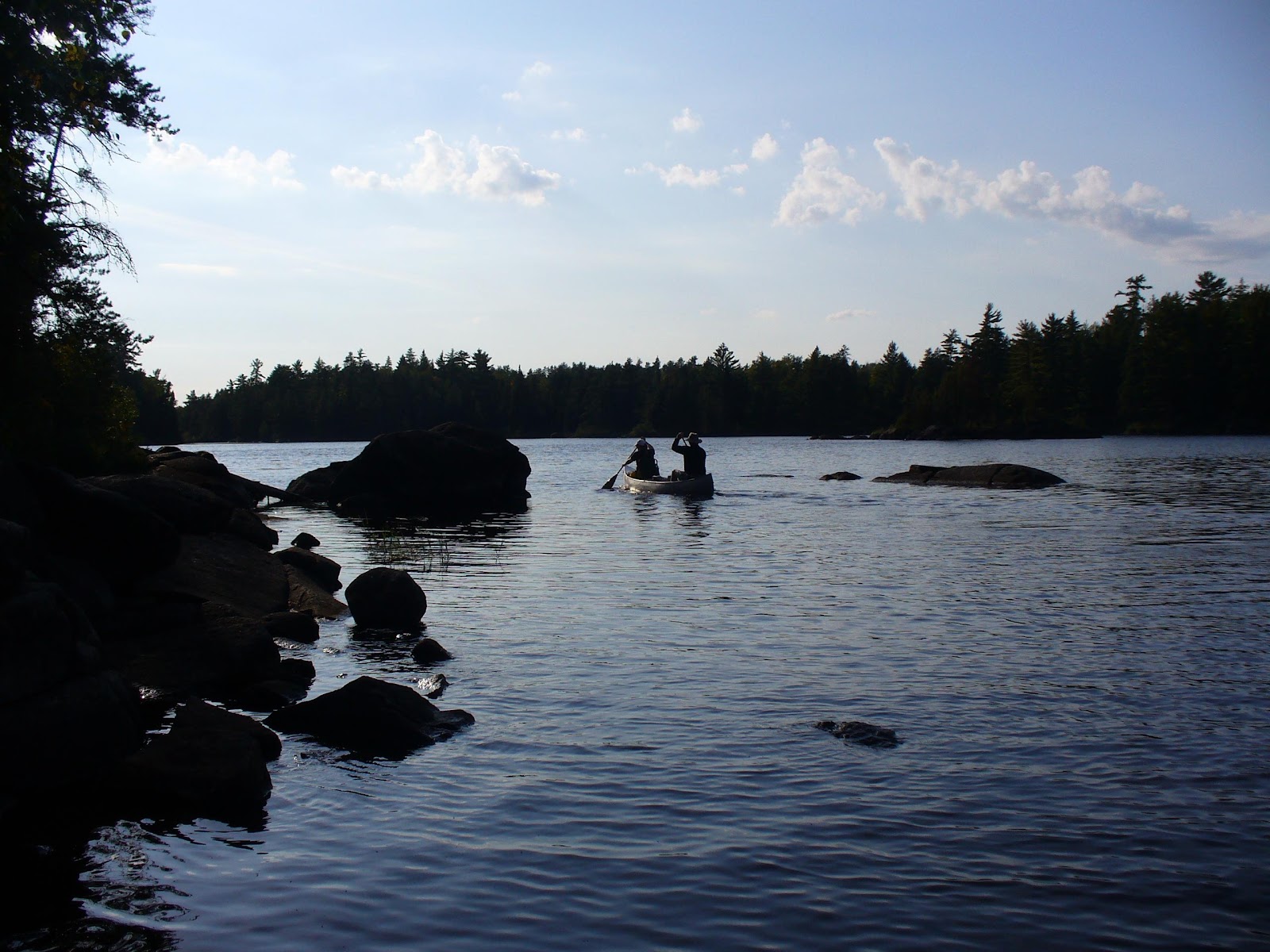
I cannot decide if I prefer to paddle in a group or if Id rather just go alone. The thing that I love most about solo paddling is that whether it's just a day trip or a multi-day trip there is no outside pressure to do anything. No schedule in a sense, unless YOU make one. You have to be disciplined enough to accomplish your goals and you are the only one responsible to push yourself. When you are alone it's all up to you.
For my first solo paddle I took it easy and went to entry point #14 Little Indian Sioux North. I have been there once before during last season, but it was at the end of a very long day so I didn't have the energy to explore. It made for an easy decision to go back. Unfortunately, due to a small wrist injury, I was not able to make it to my planned destination which was Devils Cascade. I will leave that for another day, I suppose.
I took a Northstar Magic on my trip. The Magic is my favorite solo boat to paddle. It handles better and portages better than any boat that I have tried yet. I also prefer to use a kayak paddle, that way, I feel like I am able to cover more ground.
The weather on the river was absolutely gorgeous and the wind was very mild, not a cloud in the sky. I paddled slowly down the river, stopping often to listen to the earth singing. I didn't see a single person out there even though the parking lot was packed for fishing opener.
When I first arrived at the portage I jumped out of the boat into the chilled water, I could hear water rushing. I walked back and forth along the portage until I found a good spot to sit down and read for a while. The portage is 60 rods and it leads to another segment of the river. I sat there for a good while to gather my thoughts and enjoy the sound of runningwater .
When I got back on the river I searched for a nice sunny spot on the shore where I could have some lunch. As I ate, a small family of turtles joined me on a log. They stayed there until I got up to leave.
My first solo paddle of the year wasn't very eventful but not every paddle into the Boundary Waters has to be about what you saw, how far you went or what you did. A vital part of every experience should be about how your body is feeling and most importantly how your mind is feeling when you're finished.
Luckily with the Boundary Waters so close, I never really feel like we are finished -- there's always another day and another lake to explore. Maybe I'll see you out there.
Taylor Ham, Piragis Northwoods Outfitting
...stay in touch with Your Friends in the Great Northwoods
Wednesday, May 16, 2018
Solo Canoeing -- at peace with yourself by Taylor Ham
Labels:
boundary waters,
employee blog,
solo canoe,
solo paddle,
taylor ham
I'm the Marketing Director, Catalog Director and Webmaster at Piragis Northwoods Company and the Boundary Waters Catalog here in Ely, Minnesota on the edge of the Boundary Waters Canoe Area Wilderness. We specialize in lightweight canoes and camping gear and have been serving our community and the worldwide community of paddlers since 1979. We know our stuff because we get out there and paddle. We are passionate about canoeing and wilderness.
Friday, May 11, 2018
Portage to my first Paddle of 2018 by Taylor Ham
On May 6th I woke up early before work and knew it was going to be a good day on the water. I went to work knowing that I would have to leave early so I could take advantage of the weather. With zero resistance my manager told my co-worker Joe and myself to have fun and be safe.
We left town at around 3:30 PM and had a nice drive up the Echo Trail to entry point 23 Moose River North. Its about a 45 minute drive from town. It was my first time portaging or paddling of the season. The first portage into Moose River North is about a half mile long, it is a beautiful portage that is relatively flat. It is always interesting how your body will react to the first portage of the season. Carrying a boat isn't always the most pleasant feeling but it is something over the years that I have grown to be very comfortable with.
When we got to the water I was a little relived to get the canoe off of my shoulders. As we began to paddle I started to regain skills that come with every summer I spend here in Ely. There are three portages until you get to Nina Moose. Joe and I finished our second portage and we paddled for just a few minutes until we spotted something unusual in the water ahead. It looked like small rapids, or like water was running over a stick in the water. As we got closer the movement in the water got further away and we realized that it was three small otters. We followed them up the river for about half a mile before they realized we were behind them. They swam to the shore and scurried away to the woods.
The reason I chose to go to Moose River North is because there is a high peak that you can easily climb to the top of and see all the rest of the river and Nina Moose Lake. I had been there a few times before in previous years and I wanted to see it in the spring time. Its not marked on a map anywhere but when you arrive you can see where people in the past have gotten off of the river. We climbed to the top of the hill and the wind picked up as we got out in the open. The sun came out from behind the clouds and we sat up there for a while and talked about our grand paddling plans for the season. After a while we climbed back down to our boat and paddled to Nina Moose.
Paddling rivers is very different than paddling lakes, although the rivers in the Boundary Waters don't flow very strong it is still important to read the water as it flows over rocks and other things in the water. Its a good idea to have good communication between yourself and your paddling partner to avoid the things that can damage your canoe. I would draw from the right or left from the bow seat to quickly change the direction of the boat. The person in the stern cant always see the incoming rocks so its important for the person in the bow to always be watching to protect the canoe.
We paddled to Nina Moose and the wind completely died. We spent some time there to write down our thoughts and to capture some of the science. Two swans landed in the lake and we also shared the lake with a loon. It was the first time since getting back to Ely that I had heard the call of a loon. The sun was hinting to us that it was time to start heading back. The sun was behind the trees on our way back so the temperature lowered considerably. The water was clear as glass and in the reflection you could see the shore line. We ran into a beaver that swam about 15 feet away from us before diving under us and popping back up 15 feet behind us. We also saw our otter friends again and it seemed as if two of them were fighting but they disappeared to the woods again.
Spring time is such a wonderful time to go into the Boundary Waters, even if it is just for a day trip. It's as if you get to watch the world wake up right in front of you. I'm excited for another season of padding in the most beautiful country!
I'm the Marketing Director, Catalog Director and Webmaster at Piragis Northwoods Company and the Boundary Waters Catalog here in Ely, Minnesota on the edge of the Boundary Waters Canoe Area Wilderness. We specialize in lightweight canoes and camping gear and have been serving our community and the worldwide community of paddlers since 1979. We know our stuff because we get out there and paddle. We are passionate about canoeing and wilderness.
Saturday, May 5, 2018
My First Paddle of the Year 2018
#32 South Kawishiwi River
May 2 and May 3, 2018
Adam Macht
On May 2nd, Joe and I hit the trail for my first paddle of the year. Joe had been out a few days earlier and was able to get to Devil’s Cascade out of #14 Little Indian Sioux River. This in mind, we decided we would try to get into #32 South Kawishiwi River, and if we were lucky, do the whole Kawishiwi Triangle.
The portage trail to the river was pretty rough. There were a few downed trees along the way that required a little teamwork to get the boat through. When we got to the river, we had open water, but only along the edges. We slowly made our way north when we saw a large ice sheet blocking the river. We had to break a little ice and skirt the shoreline, but we managed to get the first campsite on the west side of the river.
The ice had pulled away (maybe 15 feet) from the west shoreline. We decided to see how far north we could get. Not far. Less than a mile up, the ice was thicker than we wanted to mess with, so we decided to back track and take that first campsite. We got to camp, got all set up, and started dinner. Ribeyes, potatoes, onions, and garlic. Not a bad way to start the camping season! We had a nice fire and a relaxing evening at camp. After a long, cold winter, it was great to back in the canoe!
The warm sun hit my tent early in the morning. (I love to put my tent where it will get good morning sun in the spring and the fall.) I could hear at least 3 pileated woodpeckers and some trumpeter swans as I got out of my tent. I let my stuff dry for a bit in the sun and then got all packed up. Meanwhile, Joe slept. We were in no rush to leave camp—it was nice to have a slow leisurely morning. I started a fire and got some water boiling, and literally watched and listened to the ice melting. It was an incredibly peaceful morning.
After a little brunch, we hit the water at about noon, and decided to see how far we could get. The warm morning sun had done some work on the ice. We were optimistic that we could get further than the day before. We made our way north, skirting the west shore line, clinging to open water. Now and again, we had to paddle through an ice sheet. The ice was dark and soft and broke easily when our canoe bumped it.
Eventually, we were able to make it to Eskwagama. It was clear! We continued north to check out Clear Lake. It was open as well. We decided to keep going. We portaged north from Clear, back to the Kawishiwi River. It did not look good. The ice was pushed back into the bay, but there was a small channel of open water along the shoreline (maybe 4 feet wide). We contemplated turning around, but after some deliberation, decided to push forward. We followed the edge of the river, getting out on to shore in a couple spots as the ice was too thick to get through. Finally, things opened up a bit as we continued east.
We made it to the 200+ rod portage on the North Kawishiwi. The trail was long, and we were nervous to see if there was ice on the other side. When we finished portaging, we came out to open water, but we could see quite a bit of ice in the distance. Again, the thought of turning back crossed our minds, but we pushed onward. The NE corner of the triangle was pretty icy. At one point, we needed to cross the river to start heading south. By some stroke of luck, the ice sheet had cracked and split apart. There was a seam about 10 feet wide that we were able to use to cross the river.
We pushed south. Hugging the west shore to stay in open water. Just before the 30-rod portage near the south tip of the triangle, we ran into more ice. It was a long slog, and we had to break some ice, but we made it! It was smooth sailing after that. By this point, it was starting to get dark, but the end was in sight. We needed the headlamps for the portage out but made it back to the car without incident.
By the time you read this, I suspect the Kawishiwi Triangle will be open and ready for paddlers. The bigger lakes still need a little more time, but this was encouraging. It was so nice to knock the rust off from the long winter and get back into the canoe! Hopefully you can hit the water soon!
Adam Macht
May 2 and May 3, 2018
Adam Macht
On May 2nd, Joe and I hit the trail for my first paddle of the year. Joe had been out a few days earlier and was able to get to Devil’s Cascade out of #14 Little Indian Sioux River. This in mind, we decided we would try to get into #32 South Kawishiwi River, and if we were lucky, do the whole Kawishiwi Triangle.
![]() |
| South Kawishiwi River Portage |
The ice had pulled away (maybe 15 feet) from the west shoreline. We decided to see how far north we could get. Not far. Less than a mile up, the ice was thicker than we wanted to mess with, so we decided to back track and take that first campsite. We got to camp, got all set up, and started dinner. Ribeyes, potatoes, onions, and garlic. Not a bad way to start the camping season! We had a nice fire and a relaxing evening at camp. After a long, cold winter, it was great to back in the canoe!
![]() |
| View from my tent pad. |
The warm sun hit my tent early in the morning. (I love to put my tent where it will get good morning sun in the spring and the fall.) I could hear at least 3 pileated woodpeckers and some trumpeter swans as I got out of my tent. I let my stuff dry for a bit in the sun and then got all packed up. Meanwhile, Joe slept. We were in no rush to leave camp—it was nice to have a slow leisurely morning. I started a fire and got some water boiling, and literally watched and listened to the ice melting. It was an incredibly peaceful morning.
![]() |
| Campsite view on the morning of May 3. |
![]() |
| Lots of ice had melted by mid-morning. |
Eventually, we were able to make it to Eskwagama. It was clear! We continued north to check out Clear Lake. It was open as well. We decided to keep going. We portaged north from Clear, back to the Kawishiwi River. It did not look good. The ice was pushed back into the bay, but there was a small channel of open water along the shoreline (maybe 4 feet wide). We contemplated turning around, but after some deliberation, decided to push forward. We followed the edge of the river, getting out on to shore in a couple spots as the ice was too thick to get through. Finally, things opened up a bit as we continued east.
![]() |
| Things looking a little sketchy ahead. |
We pushed south. Hugging the west shore to stay in open water. Just before the 30-rod portage near the south tip of the triangle, we ran into more ice. It was a long slog, and we had to break some ice, but we made it! It was smooth sailing after that. By this point, it was starting to get dark, but the end was in sight. We needed the headlamps for the portage out but made it back to the car without incident.
By the time you read this, I suspect the Kawishiwi Triangle will be open and ready for paddlers. The bigger lakes still need a little more time, but this was encouraging. It was so nice to knock the rust off from the long winter and get back into the canoe! Hopefully you can hit the water soon!
Adam Macht
Thursday, April 19, 2018
Wilderness Camping is not Just a "Guy Thing" by Cara Berzins
Wilderness camping is not just a “guy thing”
Ladies, no matter what hats we wear and titles we carry, I suspect that there are some core things we all want. For example, I carry the titles mom, wife, teacher, writer. I’m always looking for ways to improve how I carry those titles. I think as women we are always looking for ways to grow, and unfortunately, we tend to doubt ourselves and wonder whether we are doing any of those things right. I know I do.
I believe I know a secret and unexpected way to build confidence and reduce doubt and guilt. This is my story of how wilderness camping shaped my identity and set me up for a happier life.
CAMPING IN THE BWCAW AS A GIRL
I was 1 year old when I visited the Boundary Waters Canoe Area Wilderness for the first time. It's a wilderness camping area of supreme quiet, endless forests, and interconnected lakes stretching across the northern border of Minnesota. Every summer, as a family of 5 and sometimes with friends, we meandered the over 1500 miles of canoe routes traversing more than 1000 lakes.
Not only did my parents get double takes because they brought young children with them into this utterly remote wilderness camping area, people noticed when two of the three little ones were girls.
As my sister and I grew, we became increasingly aware that we were a rare breed in the BWCAW. We couldn't help but feel a sense of accomplishment when we were able to load ourselves up for portages with ease while guys with other traveling groups looked on openmouthed. One of us would help the other slip her shoulders into a large bulky looking canvas canoe pack. Sometimes, to avoid coming back for another trip over the portage we would carry two packs. The other would be strapped on backwards so the backpack part hung in front. (Believe it or not, this method was actually easier because the weight was distributed more evenly!) Then the one carrying the packs would prop up the canoe as the other centered her shoulders under the yoke. Away we went after taking all of 3 minutes to load up. Seeing a teenage girl carry a canoe on her head all by herself was a shock to some of our fellow campers. Seeing how impressed they were was a huge self-esteem boost to me in the years when girls usually feel especially awkward.
The wilderness does not discriminate. When the wind howls and the waves rise into frothy whitecaps, you still need to paddle back to your campsite whether you are male or female, 8 or 80. You need the same bare minimum of gear to survive and enjoy your time in the wilderness. As yet, there is no portage concierge available to shunt these belongings from one waterway to the next. This fact makes it seem like a man's world. Instead, this very fact makes wilderness camping the great equalizer. 
WHY EVERY WOMAN SHOULD TRY WILDERNESS CAMPING
- I feel strong and sure of myself. Traveling for miles powered only by my own muscles taught me to be confident in myself and my ability to handle physically demanding situations.
- I feel a connection with nature that is strongest in this true wilderness, but helps me seek out and find that same feeling even in places where nature is scarce.
- This connection with nature is like a deep seated well of tranquility. It helps me combat anxiety and stress, which gives confidence in my emotional ability to handle demanding situations.
- Being at the mercy of the elements taught me that I can't expect things to always be easy. It also taught me not to give up when the going is hard.
- I learned to think outside the box. Sometimes you need to be innovative and learn to make do with what you have when you are traveling with the bare minimum. (Once we traded minnows for toilet paper from a group of fishermen. Priorities😉)
- I learned to distinguish between need and wants. You quickly realize what is needed and what’s not when you have to carry it all for a couple of miles.
- The value of cooperation and teamwork is obvious in the wilderness. If you aren’t paddling in unison, you get nowhere fast. If you don’t work together to set up camp, it takes twice as long.
HOW CAMPING FEELS
Some of my happiest memories are times we spent as a family camping. The sound of a paddle swishing through the water, the call of a loon, the lapping of waves, rain on the tent flaps, beavers slapping the water with their tail, various bird calls, the rustle of our feet on the portage, waterfalls thundering, wind rushing through the treetops. How often do we experience these sounds anymore? The effect they have on the mind and body is . . . I struggle to come up with the right word. Invaluable, healing, soothing, life altering.
Nancy Piragis summed it up well on the welcome video for Piragis Northwoods Company. She said, “I never forget a canoe trip. I never forget a day in the woods. But I forget days at home, I forget days in the office. . . Every single time you go out there’s always memories to be had.” You find that life has been reduced to what is right in front of you. No distractions, no rushing, no multitasking. It’s so good for your psyche and your brain.
Humans seem to be built to perform their best when at one with nature. It makes us happier, healthier, calmer. This effect has even been hitting the headlines recently. I especially enjoyed this recent episode of Innovation Hub on my local NPR station. It’s about the scientific evidence that nature is good for us.
One of the saddest side effects of modern living is that people have started to fear nature. And yet nature has so much to give us. They flood their yards with spot lights at night, they avoid uninhabited areas because they are afraid of the animals. For me, the sounds of nature are so soothing, it seems absurd to be afraid of them. I remember when I realized how much people fear nature. I was camping with friends, a single mother and her daughter. She mentioned they might not sleep well because of the noises. That night in my tent I listened with extra attention to the forest noises. Because I was listening so intently and imagining how it would sound to someone unfamiliar with the forest, my senses were all on high alert. Suddenly, I heard a terrifying, unidentifiable rumble. For a few scary moments my mind rushed through a whole series of animals until it finally dawned on me. A jet was flying high overhead! I felt relieved to finally identify the noise. But this confirmed my previous opinion; the creature most to be feared is our own species, humans. No animal noise could sound that terrifying. In the end my friends slept well, and decided they loved camping.
CONTINUING THE LEGACY
My parents gave me a priceless legacy by taking me wilderness camping as a girl. Since then we have camped with my nieces and my daughter. At first the noises and the wildness made them nervous too. But soon enough they feel just as comfortable and at home as they would in their own house. The difference is, instead of being enclosed in walls and under a roof, the lake cradles them under the vast blue sky while the forest sings its lullaby.
Experience wilderness camping for yourself. If you want to learn to believe in yourself, if you want to connect with nature more deeply than you thought possible, if you want to shake off the built-up stress and pressure of every-day life, then wilderness camping might be just the right thing for your next vacation!
Editor's note: Piragis Northwoods Outfitting offers a fully guided Women Exploring Wilderness Canoe Camping Trip. We also have Women Guides on staff as well as men, each with excellent experience in the Boundary Waters Canoe Area Wilderness. We also have all the gear you need for your trip at The Boundary Waters Catalog and for RENT.
Labels:
boundary waters,
boundary waters catalog,
cara berzins,
elli piragis,
girl scouts ely,
nancy piragis,
our story,
women canoeing,
women in the boundary waters,
women in the wilderness,
women's trips
I'm the Marketing Director, Catalog Director and Webmaster at Piragis Northwoods Company and the Boundary Waters Catalog here in Ely, Minnesota on the edge of the Boundary Waters Canoe Area Wilderness. We specialize in lightweight canoes and camping gear and have been serving our community and the worldwide community of paddlers since 1979. We know our stuff because we get out there and paddle. We are passionate about canoeing and wilderness.
Poem: Minnow Bay by Tim Stouffer
Minnow Bay
Ahead, light pours out over water so clear
that every rock is bathed in sunlight;
afternoon’s gift of warmth
to native Minnesota minnows:
Bluntnose, Creek Chub, Fathead, Golden Shiner
and Northern Redbelly Dace.
Minnows, not just smallish fish.
Like abandoned jewels encrusting the bottom,
their scales capturing shadows bouncing
from agate, quartz and granite gravel.
Pushing off the canoe with my foot in the cold water,
I don’t drag, don’t bang, don’t make a sound,
yet they scatter in schools from the over-large shadow
of the craft, giant and banana-like above,
my second summer skin,
gliding out of the bay.
How can these waters still be so clear?
How can silence still be the musical score?
How have you waited so long?
Underneath, untouched by travelers,
another world reflected.
Another chance at
freedom.
©Timothy James Stouffer 04182018
All Rights Reserved Ely, Minnesota
If you are looking for a kevlar canoe for the Boundary Waters and Beyond,
click here for our fantastic selection of canoes (tandems only way 44 lbs)
I'm the Marketing Director, Catalog Director and Webmaster at Piragis Northwoods Company and the Boundary Waters Catalog here in Ely, Minnesota on the edge of the Boundary Waters Canoe Area Wilderness. We specialize in lightweight canoes and camping gear and have been serving our community and the worldwide community of paddlers since 1979. We know our stuff because we get out there and paddle. We are passionate about canoeing and wilderness.
Subscribe to:
Posts (Atom)